
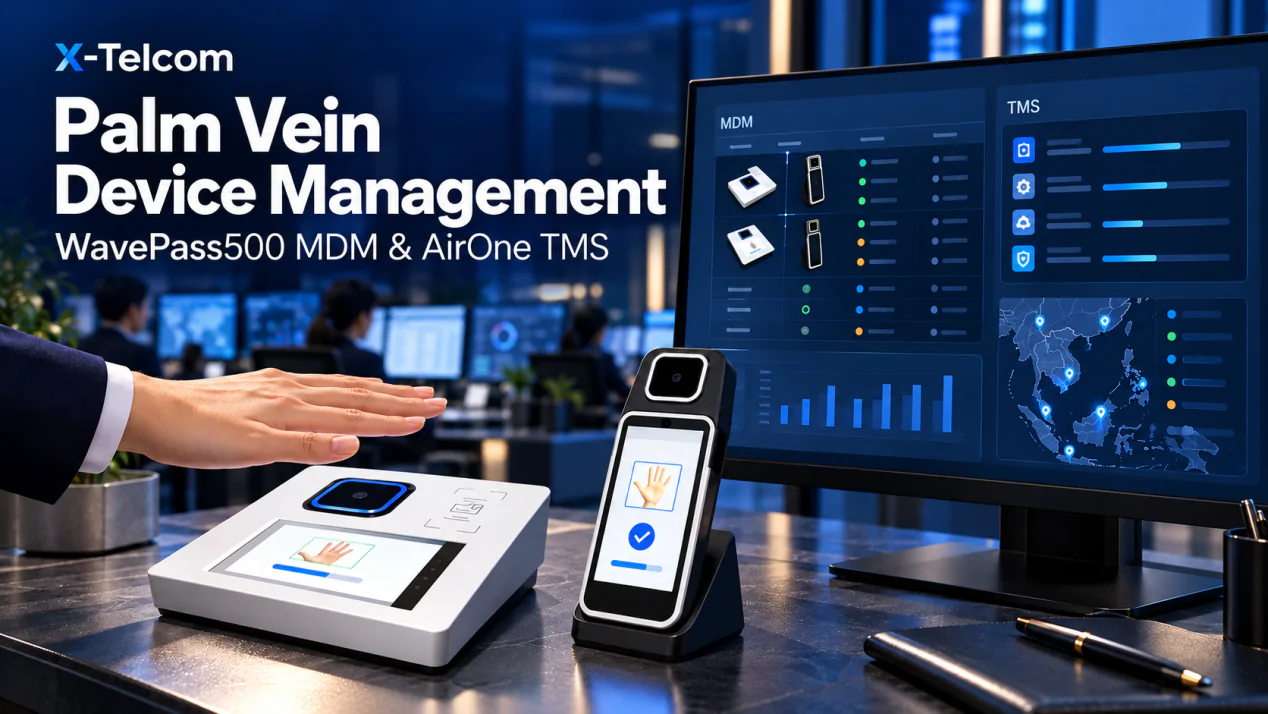
Deploying a palm vein terminal is only the beginning. As a project expands across merchant locations, bank branches or service points, teams need a practical way to manage devices, maintain application consistency and support terminals remotely.
For banks, payment providers and fintech companies, palm vein device management should be part of the deployment plan from the first pilot.
X-Telcom offers two management options for its palm vein terminals: a dedicated paid MDM platform for WavePass500 and a free TMS platform for AirOne. Understanding their capabilities and hosting arrangements helps teams select the right combination of hardware and management infrastructure.
Why Palm Vein Terminal Management Matters
A small pilot may allow technicians to configure each device individually. A distributed rollout introduces different operational needs.
Teams must organize terminals by location or project, keep applications consistent and investigate device issues without always sending technicians to the site. Procurement teams also need clarity on platform costs and hosting responsibilities before ordering hardware.
Planning the management layer early helps connect a successful palm vein pilot with a repeatable deployment process.
WavePass500 MDM: Centralized Management for Palm Vein Devices
WavePass500 uses a paid Mobile Device Management platform. It supports device administration, application deployment and policy control for palm vein biometric terminal fleets.
Device Enrollment and Grouping
Administrators can enroll WavePass500 devices, organize them by location or project and assign configurations. Last synchronization information helps teams review device communication, while bulk import and export support fleet administration.
Application and File Deployment
The MDM platform supports APK version management and configuration-based installation, update and removal actions. Teams can also distribute configuration files and certificates to selected device profiles.
These capabilities help standardize application deployment as the palm vein terminal fleet grows.
Remote Terminal Support
Support teams can review device logs and initiate remote desktop sessions after acceptance on the device. Available remote actions include reboot, lock, unlock and factory reset.
This gives administrators practical tools for investigating and addressing issues across distributed locations.
Device Policies and Kiosk Mode
WavePass500 MDM supports Wi-Fi configuration, password requirements, application restrictions and kiosk behavior. Supported controls also include URL filtering and OpenVPN configuration.
Administrators can use these settings to align terminal behavior with the intended deployment environment.
Administrative Permissions and Audit Logs
Administrator roles can restrict access to device groups or configurations. Audit logs allow teams to review administrative activity by user, action and date.
Location and geofencing functions are also available, subject to enabled plugins, permissions, device support, location services and connectivity.
AirOne TMS: Free Management for Palm Vein Payment Terminals
AirOne uses a Terminal Management System provided free as part of its payment terminal management architecture.
For teams evaluating an AirOne palm vein payment terminal project, this provides a different commercial model from the paid WavePass500 MDM platform. The specific TMS feature scope should be confirmed with X-Telcom for the project.
The WavePass500 MDM capabilities described above should not be assumed to apply to AirOne TMS.
MDM vs TMS: Costs and Private Deployment
| Consideration | WavePass500 MDM | AirOne TMS |
|---|---|---|
| Management platform | Mobile Device Management | Terminal Management System |
| Platform cost | Paid | Free |
| Customer private server deployment | Available by arrangement | Not standard |
| Private deployment conditions | Confirm licensing, deployment scope and infrastructure requirements | Minimum order of 5,000 units and project review |
| Main evaluation focus | Device policies, application deployment and remote operations | Project-specific payment terminal management requirements |
For WavePass500, the paid MDM platform can be deployed on the customer’s private server. Server sizing, connectivity, administrator access and maintenance responsibilities should be agreed before rollout.
AirOne normally uses a hosted TMS architecture. A 5,000-unit MOQ is a prerequisite for evaluating private deployment, with hosting scope and commercial terms subject to project confirmation.
Device Management and Biometric Services Are Separate Layers
Private MDM deployment does not, by itself, determine where palm vein biometric templates or payment data are stored.
Device management, palm vein recognition services and payment processing should be evaluated separately. Teams should confirm the architecture and responsibilities for each layer when planning their project.
Plan Your Palm Vein Deployment with X-Telcom
The right palm vein device management approach depends on the terminal model, fleet size, operational needs and hosting requirements.
When discussing your project with X-Telcom, share your target markets, expected device quantity, application deployment needs and private server requirements. These details help establish the appropriate management platform before moving from a pilot to a larger rollout.
Explore [X-Telcom’s Palm Vein Device Management solution] to compare WavePass500 MDM and AirOne TMS, or contact our team to discuss your deployment.