
When evaluating a palm vein authentication solution, customers often ask: Will the system stop working when the algorithm licence expires?
For banks, fintech companies and system integrators, this question affects pilot planning, operating costs and service continuity. Understanding the difference between a permanent licence and a temporary evaluation licence helps teams plan their deployment with confidence.
The Pain Point: Uncertainty About Long-Term Access
A successful palm vein pilot may lead to a wider rollout across branches, stores or self-service terminals. Before moving forward, project teams need to understand:
- Whether the algorithm requires recurring licence renewals.
- What happens when a temporary licence expires.
- Whether an expiry warning is provided.
- How registered users count towards licence capacity.
These details should be clear before the pilot begins.
Purchased X-Telcom Algorithm Licences Have No Expiry Date
Officially purchased X-Telcom palm vein algorithm licences remain valid for lifetime use. Customers do not need to renew them periodically to maintain the purchased user capacity.
Licence capacity and licence duration are separate considerations. For example, a permanent 100,000-user licence supports up to 100,000 registered users without a time-based expiry. If the project later requires more users, the customer can purchase a higher-capacity licence.
Lifetime validity refers to the algorithm licence. Any additional development or support services should be confirmed separately.
Start With a Free 10,000-User Small-Model Deployment
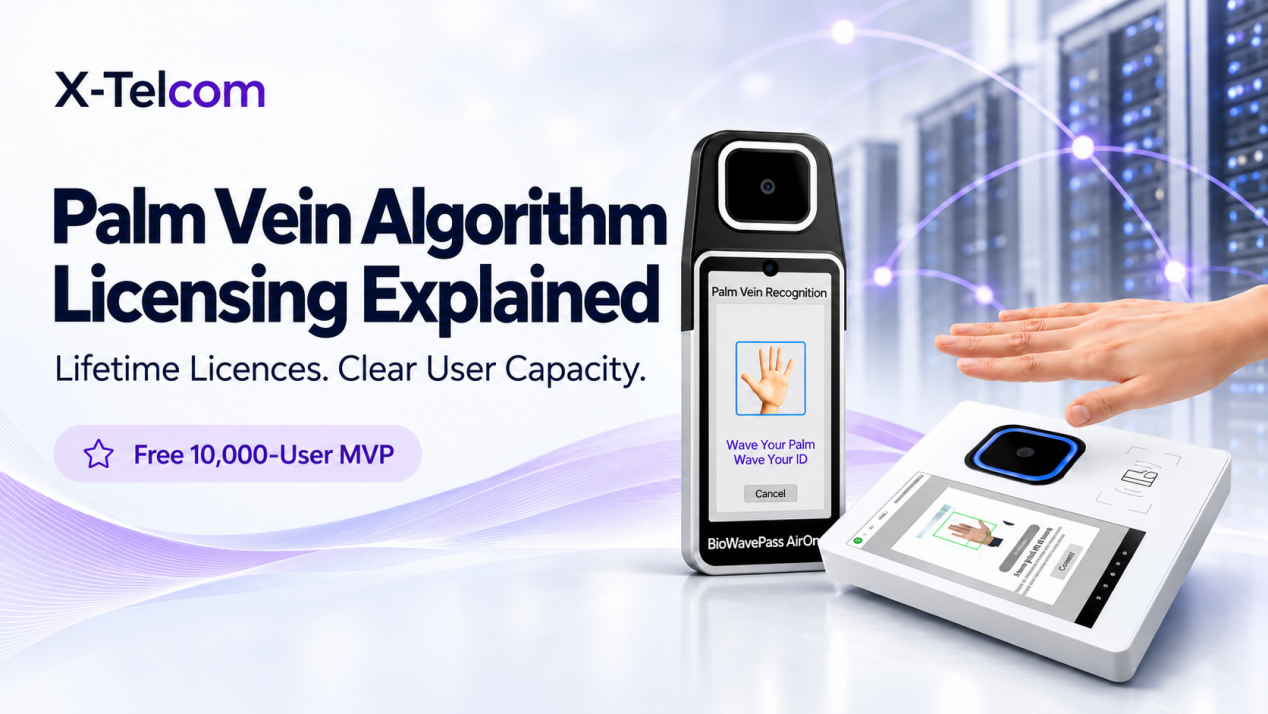
For MVP testing, X-Telcom provides a free small-model palm vein algorithm deployment supporting up to 10,000 registered user IDs on the customer’s own server.
This small-model licence has no expiry date. It gives development teams time to integrate the SDK, test their application and evaluate the authentication workflow before deciding whether a larger deployment is needed.
The free offer covers the small-model algorithm deployment. Customers remain responsible for their hardware, server infrastructure, application development and backend integration.
A Three-Month Large-Model Trial for Qualifying Partners
Customers who have placed an initial order of 100 devices and signed a strategic cooperation agreement with X-Telcom qualify for a free 100,000-user large-model algorithm deployment on their own private server.
The associated trial licence is valid for three months. This allows qualifying partners to evaluate the large-model architecture within their own project environment before purchasing a permanent licence.
The three-month validity applies to this large-model trial. It does not apply to the free 10,000-user small-model licence or officially purchased licences.
| Licence Option | Registered User Capacity | Validity |
|---|---|---|
| Free small-model licence | Up to 10,000 users | No expiry date |
| Large-model strategic partner trial | Up to 100,000 users | Three months |
| Purchased algorithm licence | According to purchased capacity | Lifetime |
What Happens When the Large-Model Trial Expires?
X-Telcom provides an expiry notification three days before the temporary large-model authorisation expires.
Once the licence expires, the algorithm service rejects requests and returns an authorisation exception with an error code. Applications should handle this response clearly so the project team can distinguish an expired authorisation from a biometric no-match result.
If a trial will support an active pilot, teams should plan the permanent licence purchase before the expiry date to avoid interruption.
Deleted Users Free Licence Capacity
X-Telcom’s user-capacity licensing is based on the number of registered users, rather than the total number of registrations performed over time.
When a registered user is deleted, that capacity becomes available for a new registration. This is useful for projects where employees, members or customers change over time.
For example, deleting 500 users from a deployment at its 10,000-user limit makes room for 500 new users.
Plan the Licence Around Your First Deployment
Before choosing a palm vein algorithm licence, define your initial registered user count, expected growth and pilot timeline.
A small pilot can help your team understand the SDK, server architecture and application workflow. If the project grows beyond 10,000 users, X-Telcom can discuss an appropriate large-model user-capacity package.