
When developing a Palm Vein Recognition system, it is easy to focus on the feature vectors used for biometric matching. However, the original palm images captured during registration also have an important long-term role.
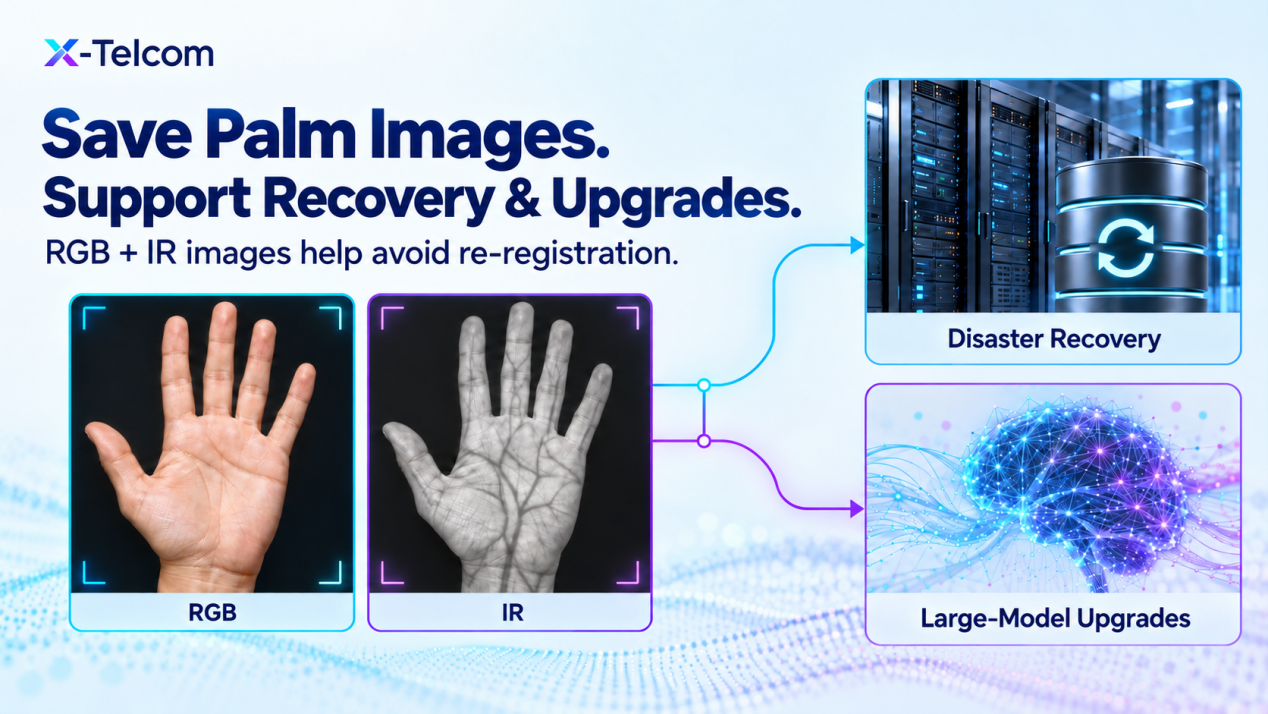
Securely retaining both the RGB palm print image and the infrared (IR) palm vein image gives your system source data from which biometric features can be extracted again. This supports two valuable capabilities: recovering biometric data after a server failure and moving to a larger algorithm model without asking users to repeat registration.
Saving images early helps avoid re-registration when moving to the large model.
What Should Be Saved During Registration?
Each registered hand produces two types of images:
- RGB image: captures the palm’s surface appearance, including palm print patterns.
- IR image: captures information used for palm vein feature extraction.
These original images are different from the feature vectors generated by the algorithm. Feature vectors are processed representations used for matching; original images provide the source material for future feature extraction.
For each registered hand, retain both image types and reliably associate them with the correct user ID. If your application registers both hands, keep each hand’s images clearly identified.
Why Keep Images If the Current Model Only Uses Features?
In X-Telcom’s small-model workflow, matching uses palm print and palm vein feature vectors extracted on the device. Original images are not required for that matching process.
The large-model workflow also uses server-side features extracted from the images. Retaining the original captures therefore prepares your platform for this transition.
| Workflow | Role of original images |
|---|---|
| Small model | Not required for current feature-vector matching, but recommended for future upgrades and recovery. |
| Large model | Used for server-side feature extraction alongside device-extracted features. |
If only the current feature vectors are retained, you may lack the source images needed for a later extraction process.
Upgrade to the Large Model Without Repeating Registration
As your platform develops, you may choose to move to the large model. If suitable RGB and IR images were saved during the original registration, the server can use those images to extract the additional features.
The upgrade workflow becomes:
Retained RGB + IR images → Server-side feature extraction → Large-model matching
This helps avoid asking existing users to return to a terminal and register their palms again.
For Palm Vein Payment Technology, access control and other biometric applications, avoiding repeat registration can reduce inconvenience for users and operational work for your team.
The best time to prepare for this upgrade is during the initial integration—not after thousands of users have registered.
Use Original Images to Support Disaster Recovery
Original palm images also provide a recovery path if biometric feature data is lost or the production server suffers a complete physical failure.
If the images and their user associations remain available in a secure backup, your team can:
- Retrieve the retained RGB and IR images.
- Prepare a replacement server with the algorithm service and the corresponding licensing arrangements.
- Re-extract biometric features from the images.
- Rebuild the links between features and user records.
- Validate the restored matching service before resuming operations.
Image retention supports rebuilding the biometric feature database. Your broader disaster recovery plan must also cover the backend data, configuration and services required by your application.
Does a Backup Server Need an Additional License?
The requirement depends on the backup server’s role.
A server that only stores original palm images does not require an additional algorithm license from X-Telcom, provided our algorithm service is not deployed on it.
If the backup server has the algorithm service deployed and is ready to perform biometric matching, a corresponding license is required.
| Backup server role | Additional algorithm license |
|---|---|
| Stores original images only; no algorithm service deployed | Not required |
| Has the algorithm service deployed and ready for matching | Required |
A storage-only backup does not itself perform biometric matching. When deploying a replacement matching server during recovery, the corresponding licensing arrangements must be addressed.
Build Image Retention Into Your Integration
Consider image retention early in your software development process:
- Save both RGB and IR images. Retain both capture types for every registered hand.
- Use quality-approved captures. Save images that pass the SDK’s
registerPalmquality check. - Maintain accurate user associations. Clearly identify the user, registered hand and image type.
- Protect the retained data. Incorporate secure storage, controlled access and backup procedures into your backend.
- Plan the recovery workflow. Confirm how images will be retrieved, features re-extracted and matching validated.
Developers can refer to the ImageUtils class in the X-Telcom SDK demo project for sample code demonstrating conversion of an image data stream into a Bitmap and saving it locally.
Prepare Today for Recovery and Future Upgrades
For Palm Vein Recognition and Palm Vein Payment Technology, original images have value beyond the initial registration.
Retaining them securely helps your platform rebuild biometric features after data loss and supports the transition to a larger algorithm model—with less disruption for existing users.
Save the original images early. Keep a recovery path available. Help users avoid registering again.