
Introduction
One of the biggest concerns when deploying biometric systems is future scalability.
Many companies worry that upgrading to a larger biometric architecture may require:
- rebuilding applications
- changing SDKs
- re-registering all users
- interrupting customer operations
X-Telcom’s palm vein platform is designed to avoid these problems.
👉 The migration from Small Model to Large Scale Model is designed to be seamless for end users.
Understanding the Small Model
The Small Model is designed for:
- MVP deployment
- pilot projects
- early-stage biometric validation
It supports:
✅ Up to 10,000 free user IDs
The Small Model uses only device-side extracted features:
- Palm Print Feature (RGB)
- Palm Vein Feature (IR)
The SDK uploads feature vectors only, while RGB + IR images are stored as backup.
Why Upgrade to the Large Model?
As biometric systems grow, customers may require:
- larger databases
- higher concurrency
- more scalable matching architecture
The Large Model introduces:
- server-side feature re-extraction
- GPU-based verification
- vector database scalability
Supporting:
✅ 100K to millions of users
How Migration Works
The migration process is designed to be technically straightforward.
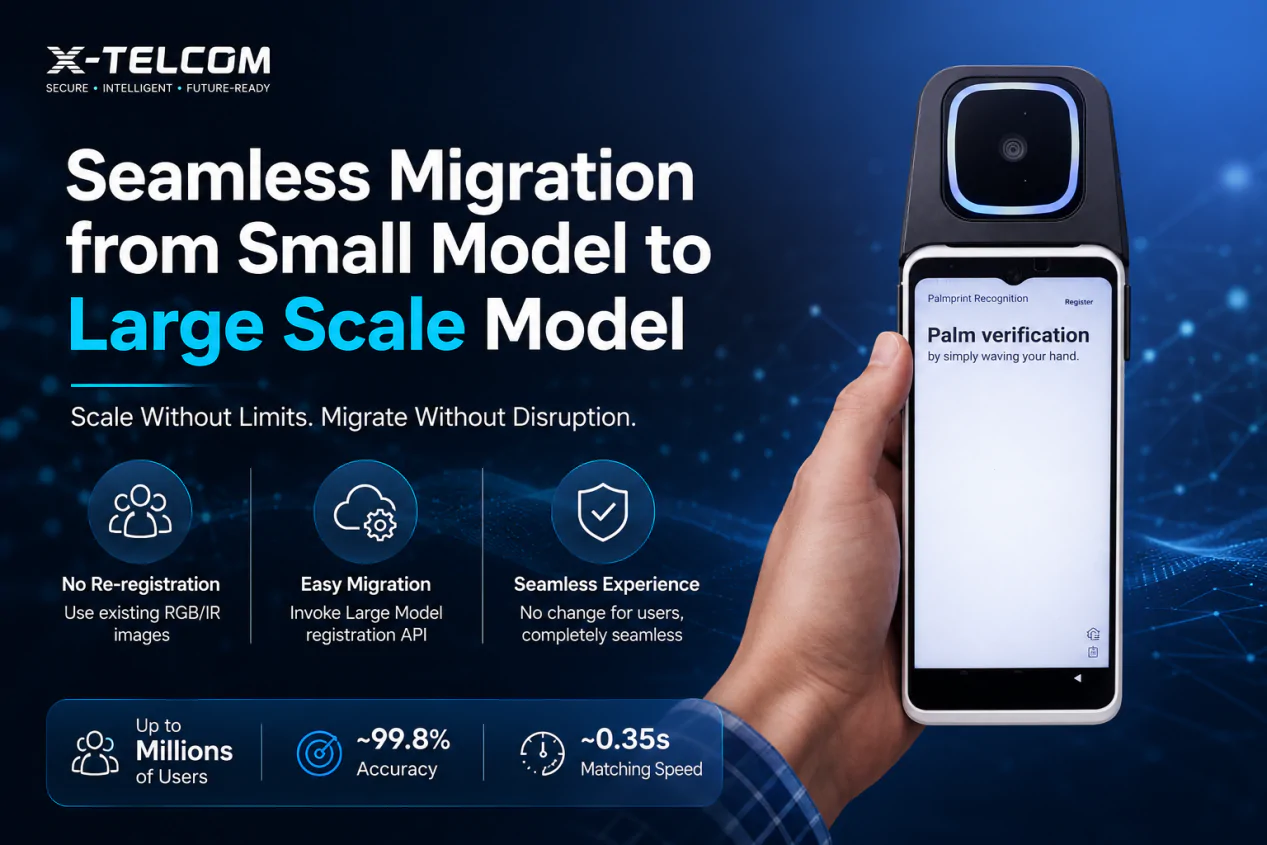
👉 Customers simply need to invoke the Large Model registration interface.
The system can then use the existing RGB + IR registration images from users originally enrolled in the Small Model system.
No Need for User Re-Registration
This is one of the most important advantages.
From the application perspective:
- the Large Model treats the process as a new registration
- existing stored RGB + IR images are used programmatically
- users are automatically migrated into the new system
However, from the user perspective:
👉 Nothing changes.
Users do not need to:
- re-register
- scan their palm again
- capture new registration images
The migration process is completely seamless to the end user.
Why Stored RGB + IR Images Matter
RGB + IR image storage is critical for future scalability.
In the Small Model:
- images are backup only
- daily matching uses feature vectors only
In the Large Model:
- the algorithm server re-extracts features from stored images
- server-side verification becomes part of the matching architecture
This enables:
- more stable large-scale matching
- scalable verification
- future algorithm optimization
Large Model Verification Architecture
The Large Model uses four verification elements:
- End-side palm print feature
- End-side palm vein feature
- Server-side palm print feature from RGB image
- Server-side palm vein feature from IR image
This dual-layer architecture helps maintain:
- high accuracy
- stable large-database performance
- scalable authentication capability
Minimal System Changes Required
Upgrading to the Large Model does not require rebuilding the entire system.
Typically, only:
👉 Device-to-server communication interfaces need adjustment to match the Large Model API specifications.
This means:
- No SDK redesign
- No major frontend rebuild
- No disruption to users
Development and Testing Support
To support migration and integration, X-Telcom provides:
- Small Model test server
- Large Model test server
- API integration support
- debugging environment
after sample purchase.
This allows customers to validate the migration process before commercial deployment.
Long-Term Scalability
With the Large Model architecture, X-Telcom supports:
- ~0.35 seconds matching speed
- ~99.8% accuracy
- million-level biometric databases
while maintaining fast real-time authentication.
Customer-Controlled Deployment
All biometric systems are deployed on customer-owned servers.
This ensures:
- full data ownership
- GDPR-compliant deployment architecture
- no vendor-side biometric data management
X-Telcom also provides:
✅ Up to 5 years large-scale algorithm support
Conclusion
A scalable biometric system should support growth without disrupting existing users.
X-Telcom’s migration architecture allows customers to:
- start with a Small Model
- scale to a Large Model
- migrate users programmatically
- avoid user re-registration
as long as RGB + IR images are stored correctly from the beginning.
Final Thought
True biometric scalability is not just about larger databases.
It is about enabling seamless migration without affecting users.
CTA
Learn more about X-Telcom Palm Vein Technology: