
Introduction
Payment terminals are no longer just transaction devices.
For fintech platforms, banks, and digital wallet providers, the next step is building payment experiences that are:
- Faster
- More secure
- More convenient
- Ready for biometric identity
This is where AirOne Palm Vein Payment POS offers a different approach.
Instead of functioning only as a traditional POS terminal, AirOne combines palm biometric authentication, EMV payment architecture, and SDK/API integration to help companies build their own palm payment ecosystem.
Traditional POS Terminals Have a Narrow Role
Most POS terminals are designed around transaction acceptance.
They usually support:
- Card payments
- NFC transactions
- QR code payments
- Merchant settlement workflows
However, they are not normally designed to support biometric identity layers.
This means they cannot easily help fintech companies build:
- Palm payment services
- Biometric wallet authentication
- Identity-linked payment systems
- Large-scale biometric user databases
AirOne is designed to solve this gap.
AirOne Adds Palm Biometric Authentication to Payment Infrastructure
AirOne integrates palm recognition into a commercial payment terminal structure.
It supports:
- Palm vein recognition using IR features
- Palm print recognition using RGB features
- Biometric authentication before payment authorization
- SDK/API connection with customer-owned platforms
This allows fintech and banking companies to connect palm identity with their own payment logic.
The result is not just a POS device, but a palm payment technology terminal.
Built on Commercial Payment Standards
For payment projects, biometric capability alone is not enough.
A palm payment device must also be compatible with real payment environments.
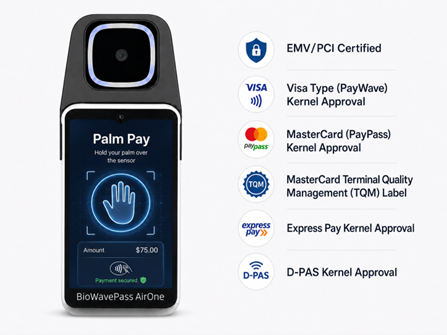
AirOne is built on a commercial payment terminal foundation supporting:
- EMV Level 1 & 2
- PCI-approved architecture
- Visa PayWave kernel
- Mastercard PayPass kernel
- Mastercard TQM
- American Express kernel
- D-PAS kernel
This makes AirOne more suitable for fintech and banking integration than demonstration-only biometric scanners.
SDK/API Integration for Fintech Platforms
AirOne is built for software teams that want to integrate palm authentication into their own systems.
Supported Integration Options
- Android Java SDK
- Android Flutter SDK
- RESTful API
- Cloud verification architecture
- Private server deployment
Secure Transmission and Storage
- HTTP + SSL encrypted transmission
- AES-256 CBC cloud storage encryption
- Encrypted on writing
- Decrypted on reading
This structure helps customers build secure biometric payment systems while keeping control of their own platform and data.
From Passwords to Palm Authentication
Traditional payment flows often depend on:
- PIN codes
- Passwords
- Cards
- Mobile devices
AirOne enables a different user experience:
Palm-based authentication.
By combining RGB palm print features and IR palm vein features, the system can support secure, contactless identity verification for payment scenarios.
This helps fintech companies explore passwordless and cardless payment experiences.
Designed for MVP and Large-Scale Growth
A key difference between AirOne and traditional POS terminals is scalability.
AirOne supports both:
- Small Model architecture for MVP testing
- Large Scale Model architecture for commercial deployment
This allows customers to start small and scale later without redesigning the full system.
Small Model for MVP Testing
The Small Model is designed for early project validation.
It supports:
Up to 10,000 free user IDs
The system uses:
- End-side Palm Print Feature (RGB)
- End-side Palm Vein Feature (IR)
Only feature vectors are uploaded for matching.
RGB + IR images are stored as backup, not used for daily matching.
This helps fintech teams test the business model with lower infrastructure requirements.
Large Scale Model for Commercial Deployment
When user volume grows, AirOne can support migration to the Large Scale Model.
The Large Model introduces:
Server-side feature re-extraction from stored RGB + IR images.
It uses four verification elements:
- End-side palm print feature
- End-side palm vein feature
- Server-side palm print feature
- Server-side palm vein feature
This architecture supports:
- ~0.35s matching speed
- ~99.8% accuracy
- Million-level biometric databases
Seamless Migration Without User Re-Registration
AirOne is designed with future growth in mind.
When moving from Small Model to Large Scale Model:
- Existing RGB + IR images can be reused
- The Large Model registration interface can be invoked programmatically
- Existing users can be registered into the new algorithm service without scanning again
From the user’s perspective, nothing changes.
They do not need to:
- Re-register
- Scan their palm again
- Repeat the onboarding process
This reduces migration risk and protects the existing user experience.
Enterprise Deployment Capabilities
AirOne also supports operational requirements for real-world fintech deployment.
These include:
- TMS management
- OTA support
- Android kiosk mode
- Remote diagnostics
- Fleet management
These functions help customers manage distributed payment devices across multiple locations.
Customer-Owned Deployment Architecture
For banking and fintech projects, data ownership is critical.
AirOne supports:
- Customer-owned private server deployment
- GDPR-compliant architecture
- Customer-controlled biometric data
X-Telcom provides hardware, algorithms, and integration support, but does not manage the customer’s biometric database.
This helps reduce vendor dependency and supports compliance-driven deployment.
Conclusion
Traditional POS terminals are mainly designed to process payments.
AirOne Palm Vein Payment POS is designed to support a broader payment architecture:
- Palm biometric authentication
- EMV payment infrastructure
- SDK/API integration
- MVP-to-large-scale algorithm migration
- Customer-controlled deployment
This makes AirOne suitable for fintech and banking companies that want to build their own palm payment systems.
Final Thought
AirOne is not just a POS terminal.
It is a palm payment technology terminal built for biometric fintech integration.
CTA
Learn more about AirOne Palm Payment Technology: