
A customer has a bank account, a digital wallet and memberships with several retailers. At checkout, they may need a card to pay, a phone number to collect points and an app to redeem an offer.
These services serve the same person, but each asks them to identify themselves differently.
Palm authentication gives banks and fintechs another way to connect those interactions. With the customer’s consent and the necessary integrations, a palm scan can help a platform identify the account holder and bring the relevant services into the checkout flow.
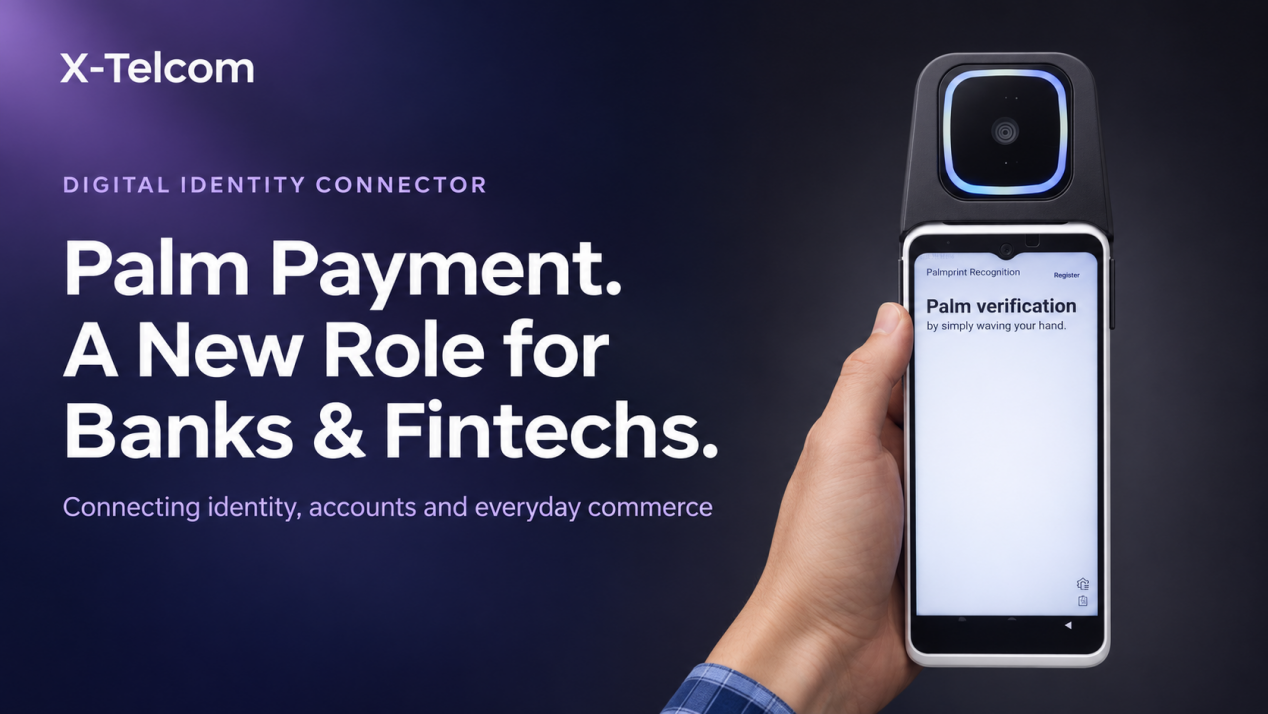
For X-Telcom, this is one of the useful opportunities behind palm payment: helping banks and fintechs take on the role of a Digital Identity Connector.
What Is a Digital Identity Connector?
A Digital Identity Connector links an authenticated person to the accounts and services they are authorised to use.
In a palm payment application, the platform associates a registered palm identity with an existing customer record. When the customer scans their palm again, the recognition service returns a matching result. The business platform uses that result to locate the appropriate account and continue its verification or payment workflow.
The palm is a way to recognise the customer. The bank or fintech remains responsible for the account relationship and for deciding what happens next.
A successful palm match does not establish a customer’s legal identity, complete KYC or approve a transaction on its own.
For Banks: Make the Verified Customer Account Easier to Access
Banks already maintain relationships with customers whose identities have been verified through their onboarding processes.
Palm authentication can provide another way for those customers to access connected services. During enrolment, the bank’s application links the palm registration to the correct customer account, following its authentication and consent procedures.
At a participating store, a subsequent palm scan can help identify that account holder. The bank’s systems then apply the relevant account checks, transaction limits and authorisation requirements.
Customers may be able to access their account at checkout without taking out a card or opening an app, where the service and its security requirements support that experience.
For the bank, this creates an opportunity to become more present in everyday purchases through its merchant network.
For Fintechs: Connect Wallets, Merchants and Business Systems
Fintech platforms often sit between several systems: a wallet, a merchant’s POS application, a payment gateway and a membership database.
Palm recognition can provide an identity verification step within that workflow.
For example, after a customer scans their palm, the fintech’s backend could identify the associated wallet account. If the customer has also agreed to link a retailer’s membership, the platform could retrieve the relevant membership record before presenting the payment for authorisation.
The customer makes one gesture, while the platform coordinates the separate services behind it.
That experience requires software integration. Installing a palm vein scanner does not automatically connect merchant accounts, wallets or loyalty programmes. The fintech must define which records are linked, what each participant may access and how the customer can manage those connections.
Done well, this gives the fintech a stronger role in the merchant’s daily operations, covering both payment access and customer identification.
How Palm Identity Connects to a Business Account
A typical implementation separates biometric recognition from business decisions:
-
Confirm the customer’s account.
The bank or fintech authenticates the customer through its existing onboarding or account-access process. -
Register the palm with consent.
The device captures the required palm images, and the application submits the registration request to the recognition service. -
Associate the registration with the customer record.
The business backend maintains the relationship between the recognition identifier and its own account identifier. -
Use the match result in the application.
During a later palm scan, the recognition service returns a result. The platform checks that response and applies its business rules before proceeding.
In X-Telcom’s large-model architecture, the customer’s application defines the user_id at registration. The device-side component handles palm image selection and capture, while the server-side algorithm service performs matching.
The application must interpret the server’s return codes and handle successful registrations, failed matches and other errors. These responses need to become clear actions in the customer’s own application.
A Connected Experience Does Not Require Sharing Every Record
Connecting services does not mean giving every merchant access to the same customer database.
A retailer may need a membership reference or a payment authorisation result. It generally has no operational reason to receive the customer’s biometric images or full banking profile.
A practical design should define the information needed for each interaction and keep access limited to that purpose. It should also give customers a clear way to enrol, withdraw consent and unlink services.
For projects using X-Telcom’s large-model image encryption interface, customers can implement and manage their own image encryption and decryption in accordance with the required AES-256-GCM specification. Compatibility should be verified during integration.
These decisions belong in the project design from the start, alongside the checkout experience.
Start with One Useful Customer Journey
The first deployment does not need to connect every service.
A bank could begin with palm-based account identification at a small group of participating merchants. A fintech could start with one wallet and one retailer, then assess whether linking membership adds enough value to justify the extra integration.
The early questions are practical:
- Can customers enrol without staff having to explain every step?
- Is it clear which account will be used?
- What happens if recognition fails?
- Can customers continue with another payment method?
- Do customers choose to use palm authentication again?
A focused pilot gives the team a chance to resolve these details before expanding the service.
Where X-Telcom Fits
X-Telcom provides palm recognition hardware, SDKs and APIs for banks, fintechs and system integrators building their own applications.
Our role is to support palm capture and recognition integration. The customer’s platform manages account relationships, consent, transaction authorisation and payment processing.
For banks, the opportunity is to make a verified account easier to use across everyday services. For fintechs, it is to connect those services through a consistent identity verification experience.
That is the role of a Digital Identity Connector: helping the right person access the right account or service, with fewer steps.
[Contact X-Telcom] to discuss the customer journey you want to improve, the systems involved and how you plan to link the customer’s identity to their account.