
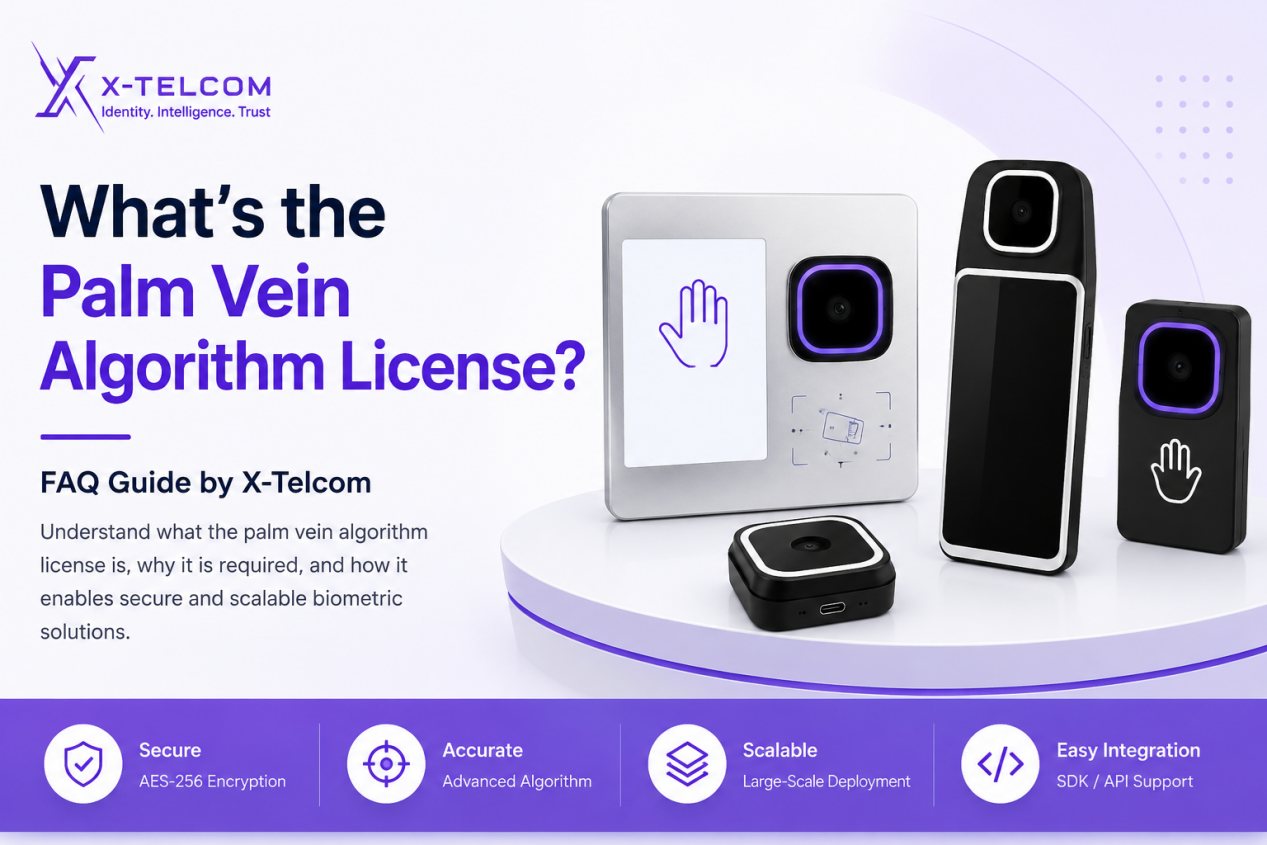
FAQ Guide by X-Telcom
As palm vein recognition becomes more widely used in payment, identity verification, access control, workforce attendance, healthcare, fintech, and government-related projects, many customers are beginning to understand that a complete biometric solution is not only about the hardware device.
One common question is:
“What exactly is a palm vein algorithm license, and why is it required?”
This FAQ explains the concept in a simple and practical way.
1. What Is a Palm Vein Algorithm License?
A Palm Vein Algorithm License is the commercial usage right that allows a customer to use X-Telcom’s palm vein recognition engine inside their own system, platform, or application.
It is not a hardware fee.
It is not a data storage fee.
It is the license for using the core biometric algorithm that performs palm image processing, feature extraction, palm vein matching, database comparison, and identity verification.
In simple terms:
- The device captures the palm image.
- The customer’s system stores and manages the data.
- The algorithm identifies and verifies the user.
Without the algorithm license, the device can capture palm images, but the customer cannot commercially use X-Telcom’s recognition engine for large-scale biometric applications.
2. Why Is the Algorithm License Separate from the Hardware?
The hardware and the algorithm have different roles.
The palm vein device is responsible for capturing palm images and palm vein data through RGB and NIR imaging.
The algorithm is responsible for converting those images into usable biometric features and matching them against a registered database.
This is similar to many technology products in the market.
A camera can capture an image, but facial recognition requires a recognition engine.
A scanner can scan a document, but OCR requires a text recognition engine.
A computer can run software, but commercial software still requires a valid license.
Palm vein recognition follows the same logic.
The device is the capture tool.
The algorithm is the recognition engine.
3. What Does the X-Telcom Algorithm License Package Include?
The X-Telcom palm vein algorithm license package supports commercial biometric deployment and system integration.
It includes:
- Palm image processing
- RGB and NIR feature extraction
- Palm print and palm vein matching
- Database comparison capability
- SDK/API integration support
- Algorithm deployment package
- Technical documentation
- Commercial usage rights
- Large-scale user ID support
The license is not simply a “user ID fee”.
It is the commercial authorization to use X-Telcom’s palm vein recognition capability inside the customer’s own business system.
4. If the Data Is Stored on the Customer’s Own Server, Why Is a License Still Needed?
Because data ownership and algorithm usage rights are different.
At X-Telcom, all palm vein data and photos are encrypted with AES-256 and stored only on the customer’s own system. X-Telcom does not participate in any data management. The customer owns and controls the system and data, with full compliance and GDPR alignment.
However, even when the data is stored on the customer’s own server, the recognition process still depends on the algorithm engine.
The customer owns the data.
X-Telcom provides the algorithm, SDK, deployment package, and technical support.
The license fee is for the commercial use of the algorithm, not for storing or managing the customer’s data.
5. Can You Give a Simple Market Example?
Yes.
Microsoft charges for Windows or Office licenses, even if the software is installed on your own computer.
Google Maps charges businesses for API usage when map services are integrated into commercial platforms.
OCR providers charge for text recognition capability, not for the scanner itself.
AI recognition platforms charge for recognition algorithms, not for camera hardware.
Antivirus companies charge for the security engine and update service, not for the computer hardware.
Palm vein recognition is similar.
The hardware captures the palm image.
The customer’s server stores the data.
The algorithm performs the recognition.
This is why the algorithm license is required for commercial deployment.
6. Is the Palm Vein Algorithm License Only for Payment Projects?
No.
The palm vein algorithm license can support many application scenarios, including:
- Palm payment
- Identity verification
- Access control
- Time and attendance
- Healthcare authentication
- Fintech user verification
- Government subsidy distribution
- Campus payment and identity systems
- Retail membership identification
- Transportation and ticketing verification
Any project that needs palm vein recognition at commercial scale requires a valid algorithm license package.
7. Does X-Telcom Support POC Testing Before Commercial Licensing?
Yes.
For POC and MVP testing, X-Telcom supports customers with a free license for up to 10,000 user IDs.
This allows customers to test the hardware, SDK, integration process, server deployment, and business model before purchasing a larger commercial license.
Once the project moves from testing into commercial rollout, customers can choose the suitable license package based on their required user ID volume.
8. Why Is the Algorithm Important for Large-Scale Deployment?
Small-scale testing and large-scale commercial deployment are very different.
In real business environments, the system must support:
- Stable recognition accuracy
- Fast matching speed
- Large database comparison
- Secure biometric processing
- Reliable SDK/API integration
- Long-term technical support
- Smooth upgrade from MVP to commercial operation
This is why the algorithm layer is critical.
Palm vein recognition is not only about capturing a palm image.
It is about accurately verifying a user in a secure, scalable, and commercially reliable way.
9. Final Summary
A palm vein device is the hardware capture tool.
The customer’s own server stores and controls the biometric data.
The X-Telcom palm vein algorithm license provides the commercial right to use the recognition engine.
Therefore, the license fee is not a storage fee, and it is not simply a hardware cost.
It is the commercial license for using X-Telcom’s core biometric recognition technology inside the customer’s own platform.
For customers building palm payment, identity verification, access control, attendance, healthcare, fintech, or large-scale authentication systems, the algorithm license is what allows the solution to move from basic testing to real commercial deployment.
Contact X-Telcom
To learn more about X-Telcom palm vein devices, SDK integration, and algorithm license packages, please visit: