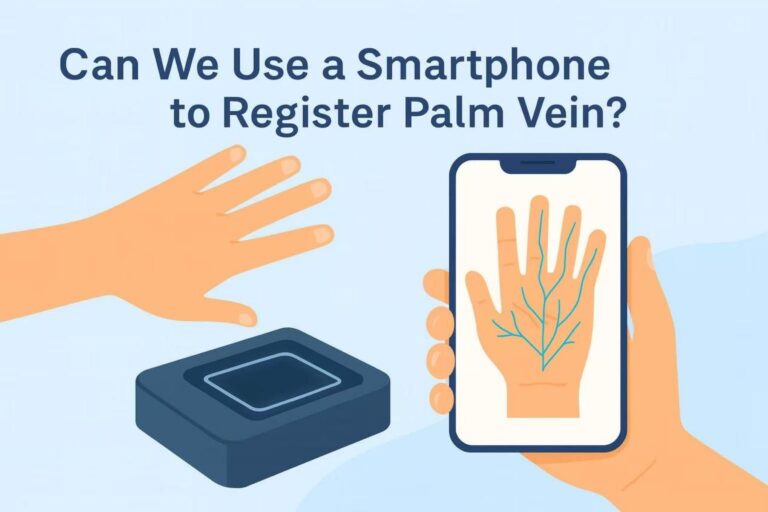

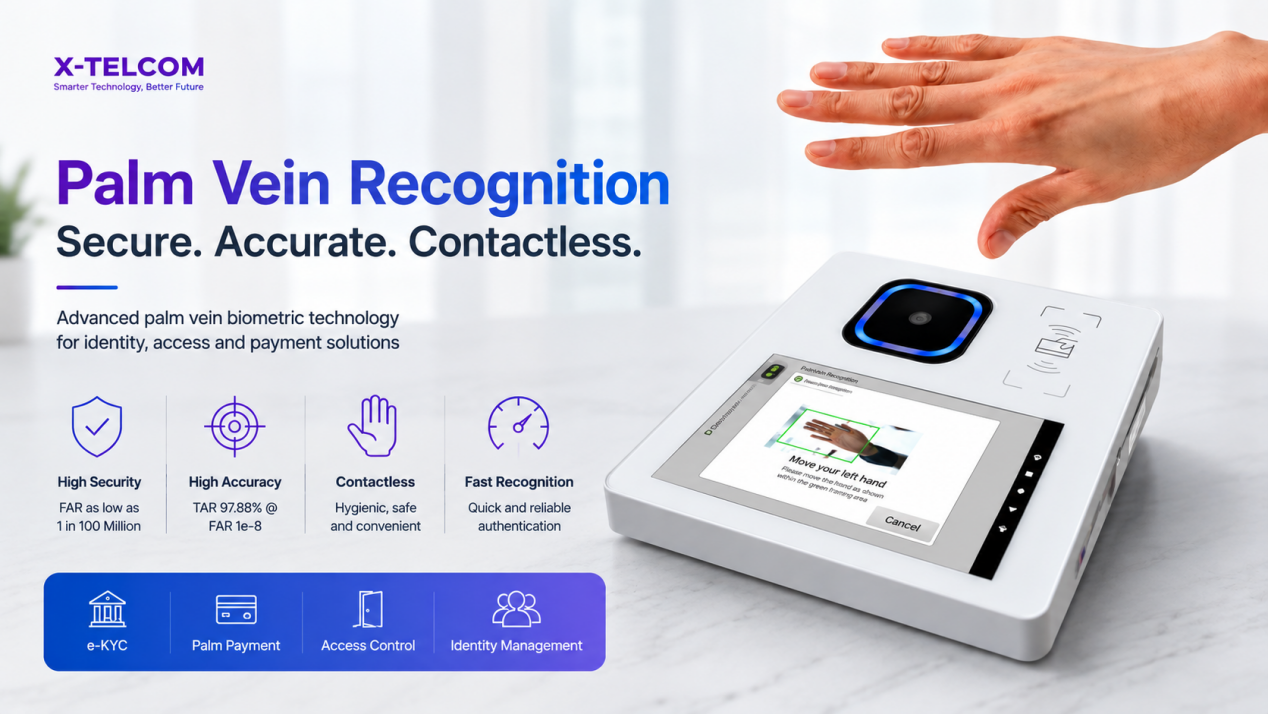
As palm vein recognition moves from small biometric projects into large-scale e-KYC, digital identity, biometric authentication and palm payment applications, one of the most important questions is:
How accurate is palm vein recognition when the number of registered users becomes very large?
For a biometric system, accuracy cannot be measured by a single percentage. Factors such as False Acceptance Rate (FAR), False Rejection Rate (FRR), True Acceptance Rate (TAR), liveness detection, database size and matching architecture all need to be considered.
X-Telcom’s BioWavePass palm recognition technology has been developed with different algorithm architectures for different deployment scales, from initial testing with up to 10,000 users to commercial deployments involving hundreds of thousands or millions of identities.
What Is Palm Vein Recognition?
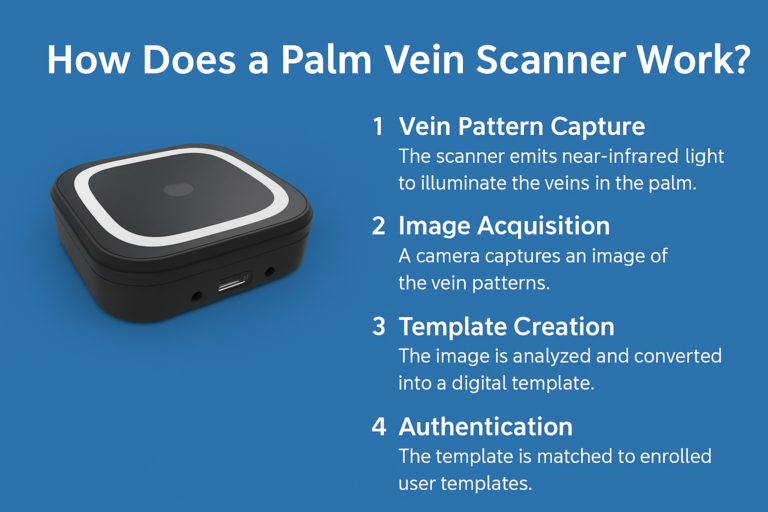
Palm vein recognition is a biometric authentication technology that uses near-infrared imaging to capture the unique vascular patterns beneath a person’s palm.
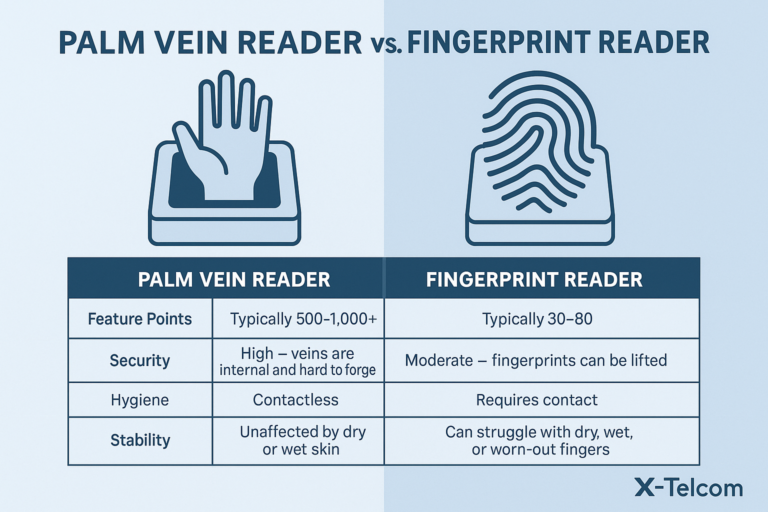
Unlike conventional fingerprint recognition, palm vein authentication analyses biometric characteristics beneath the skin. X-Telcom’s palm recognition solution combines RGB palmprint and NIR palm vein information to provide multimodal biometric verification.
This technology can be used in applications such as:
- e-KYC and digital identity
- Palm payment
- Banking authentication
- Enterprise identity verification
- Access control
- Healthcare identification
- Government identity projects
- Self-service terminals and kiosks
How Accurate Is X-Telcom Palm Vein Recognition?
X-Telcom evaluates several separate components of the biometric process, including palm detection, liveness detection and palm matching.
For the large-scale algorithm, test results include:
| Algorithm | Performance Metric | Test Result |
|---|---|---|
| Palm Detection | Precision @ Recall | 99.64% @ 99.96% |
| Palm Liveness Detection | TAR @ FAR | 98.69% @ 1×10⁻³ |
| Palm Matching | TAR @ FAR | 97.8779% @ 1×10⁻⁸ |
The palm matching evaluation was conducted using a dataset at the scale of hundreds of millions of records.
Images belonging to the same identity were compared to calculate the True Acceptance Rate, while images belonging to different identities were compared to evaluate the False Acceptance Rate.
This scale of testing is particularly important when evaluating biometric technology for high-volume identity and payment applications.
What Do FAR, FRR and TAR Mean in Biometrics?
Three metrics are particularly important when evaluating a biometric recognition system.
False Acceptance Rate (FAR)
FAR measures how often a biometric system incorrectly accepts an unauthorized person.
A lower FAR generally represents stronger protection against incorrect identity matches.
For example:
FAR = 1×10⁻⁸
represents a false acceptance probability of approximately one in 100 million comparisons under the stated test conditions.
X-Telcom’s large-scale palm matching algorithm achieved:
97.8779% TAR at FAR = 1×10⁻⁸
False Rejection Rate (FRR)
FRR measures how often a legitimate registered user is incorrectly rejected by the biometric system.
A biometric system therefore needs to balance security and user experience.
Making the acceptance threshold extremely strict may reduce false acceptance, but it can also increase false rejection.
True Acceptance Rate (TAR)
TAR measures how successfully legitimate users are accepted at a specified FAR.
This is why statements such as "99% accurate" are generally insufficient when evaluating a professional biometric system. The operating threshold and corresponding FAR, FRR or TAR should also be considered.
Why Does Database Size Matter in Palm Vein Recognition?
A biometric algorithm designed for 1,000 users does not necessarily have the same requirements as an algorithm designed for one million users.
As the biometric database grows, the number of potential comparisons increases significantly.
X-Telcom therefore provides two algorithm architectures for different deployment requirements.
Small-Model Palm Recognition Algorithm
The small model is primarily designed for evaluation, proof-of-concept projects and applications with up to 10,000 registered user IDs.
It includes:
- Free license for testing
- Maximum 10,000 user IDs
- 2 algorithm models
- 2 matching scores
- RGB palmprint recognition
- NIR palm vein recognition
Under the current default threshold, the small-model algorithm achieves:
| Modality | Performance |
|---|---|
| RGB Palmprint | FRR 1.002% @ FAR 1×10⁻⁶ |
| NIR Palm Vein | FRR 1.52% @ FAR 1×10⁻⁶ |
Both modalities therefore individually reach a FAR level of one in one million.
Because the system uses both RGB palmprint and NIR palm vein modalities, false acceptance would require both modalities to fail simultaneously. Under the stated methodology, the combined false acceptance risk can be reduced to the level of one in hundreds of billions.
Large-Model Palm Recognition Algorithm
For commercial applications requiring significantly larger biometric databases, X-Telcom provides its large-model algorithm.
The architecture includes:
- 8 algorithm models
- 10 matching scores
- Support for hundreds of thousands to tens of millions of users
- Derived comparison data reaching hundreds of millions
- Private server deployment
- Scalable QPS configuration
Unlike the free small model, the large model is a commercial algorithm solution designed for high-volume deployment.
This makes it particularly relevant to large-scale e-KYC, digital identity, banking and palm payment projects.
Why Is Liveness Detection Important?
Biometric recognition is not only about determining whether two biometric templates belong to the same person.
A secure biometric system should also determine whether the biometric sample originates from a genuine person rather than an attempted presentation attack.
X-Telcom’s palm liveness detection testing included tens of millions of spoof attack samples, including:
- Printed paper fake hands
- Plastic fake hands
- Silicone fake hands
- Gloves
- Other presentation attack samples
At a spoof False Acceptance Rate of 0.1% (FAR = 1×10⁻³), the True Acceptance Rate for genuine palm samples reached:
98.69% TAR @ FAR 1×10⁻³
Liveness detection is particularly important for applications involving payments, e-KYC, banking and high-security identity authentication.
Can Palm Vein Recognition Be Deployed on a Private Server?
Yes.
X-Telcom supports private deployment of its palm recognition algorithm.
The required infrastructure depends on database capacity and expected transaction throughput.
Reference server configurations include:
| Database Capacity | 100K | 500K | 1M |
|---|---|---|---|
| QPS | 10 | 50 | 100 |
| RAM | 4 × 32 GB | 8 × 32 GB | 8 × 32 GB |
| Storage | SSD 1 TB | SSD 2 TB | SSD 2 TB |
| GPU | NVIDIA L4 | NVIDIA L4 | 2 × NVIDIA L4 |
The reference configurations use Intel Xeon Gold 6226 processors, with infrastructure scaling according to database capacity and QPS requirements.
Private deployment can be particularly important for banks, payment providers, government organisations and large enterprises that require greater control over their biometric infrastructure.
Which X-Telcom Device Is Used for Palm Recognition?
The performance testing described in this article uses the X-Telcom PalmVein01 module for indoor applications.
PalmVein01 combines RGB and NIR imaging and can be integrated into applications such as:
- POS terminals
- Payment kiosks
- e-KYC terminals
- Access control systems
- Self-service machines
- Banking terminals
- Custom Android, Linux and Windows solutions
For larger commercial projects, palm recognition technology can form part of a broader biometric identity ecosystem rather than operating simply as a standalone scanner.
Palm Vein Recognition for e-KYC and Digital Identity
Large-scale e-KYC applications require more than biometric capture.
A commercial deployment may involve:
Palm Capture → Liveness Detection → Feature Extraction → Biometric Matching → Identity Verification → Business Application
The biometric layer therefore needs to integrate with the customer’s existing identity platform, database and business systems.
For government, financial and enterprise applications, private server deployment can also allow the organisation to maintain greater control over its identity architecture.
Palm Vein Recognition for Payment
Palm payment represents another important application for large-scale biometric matching.
Instead of relying only on a physical card, QR code or mobile phone, a registered user’s palm can become part of the authentication process.
A complete palm payment ecosystem may involve:
Palm Recognition + User Identity + Payment Account + Payment Gateway / Acquirer + Certified Payment Hardware
This is why palm payment should not be considered simply a biometric hardware project.
Successful deployment may require cooperation between biometric technology providers, banks, payment processors, fintech companies, payment gateways and local ecosystem partners.
X-Telcom’s BioWavePass technology is designed to provide the palm recognition technology, hardware, algorithms and integration capabilities required as part of such an ecosystem.
Frequently Asked Questions About Palm Vein Recognition
How many users can the free X-Telcom palm vein algorithm support?
The small-model algorithm supports up to 10,000 registered user IDs and is primarily intended for testing, proof-of-concept projects and smaller deployments.
What happens if my project needs more than 10,000 users?
Projects requiring larger biometric databases can use X-Telcom’s commercial large-model algorithm, which is designed for hundreds of thousands to tens of millions of users.
What is the FAR of the X-Telcom palm matching algorithm?
In the documented large-scale palm matching test, the algorithm achieved:
97.8779% TAR at FAR 1×10⁻⁸
Does X-Telcom palm recognition include liveness detection?
Yes. The documented palm liveness detection test achieved 98.69% TAR at FAR 1×10⁻³, using spoof samples including printed paper, plastic and silicone fake hands, gloves and other presentation attack samples.
Can the X-Telcom palm vein algorithm run on a private server?
Yes. X-Telcom supports private server deployment and provides reference server configurations according to biometric database size and required QPS.
Does X-Telcom provide technical support for algorithm deployment?
Yes. Depending on commercial requirements, support can include:
- Algorithm service deployment assistance
- Algorithm model upgrades
- SDK upgrades
- Offline case analysis and optimisation
- Algorithm risk-control strategy implementation
Building Large-Scale Palm Vein Recognition Solutions
Palm vein recognition is moving beyond traditional access control into e-KYC, digital identity, banking, fintech and biometric payment applications.
For these projects, selecting the right palm vein technology requires evaluating more than scanner hardware.
Algorithm performance, FAR, FRR, TAR, liveness detection, database scalability, server architecture and integration capability all become important when moving from a proof of concept to a large-scale commercial deployment.
X-Telcom and BioWavePass provide palm recognition hardware, algorithms, SDK/API integration and deployment support for organisations developing biometric identity and palm payment solutions.
For an initial proof of concept, customers can begin with the 10,000-user small-model environment before evaluating the large-model architecture required for commercial-scale deployment.
## Talk to X-Telcom About Your Palm Vein Project
If you are developing a solution involving palm vein recognition, e-KYC, digital identity, biometric authentication or palm payment, contact X-Telcom to discuss your application, expected user capacity and integration requirements.