
Introduction
As biometric authentication becomes increasingly adopted across payments, banking, digital identity, and public services, security remains one of the most important considerations.
A common question from financial institutions and payment providers is:
Can palm vein authentication be spoofed?
The answer is not simply whether an attack is theoretically possible, but whether it is practical, scalable, and economically viable.
At X-Telcom, we evaluate biometric security from both technical and commercial perspectives. Effective security is achieved not only through advanced anti-spoofing algorithms but also by making attacks increasingly difficult, expensive, and impractical.
Multi-Layer Security by Design
Modern biometric security should never rely on a single verification factor.
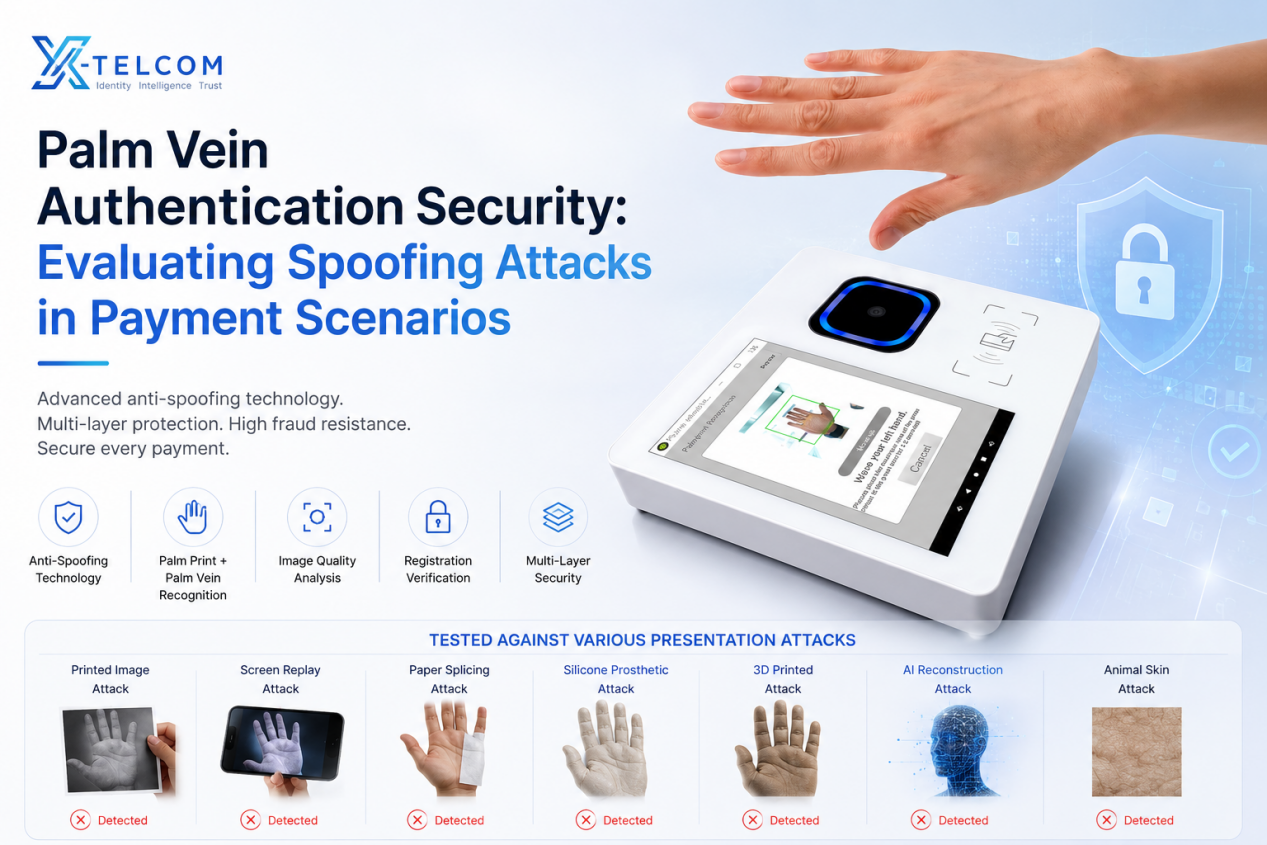
X-Telcom’s palm authentication technology combines:
- Palm print recognition
- Palm vein recognition
- Image quality analysis
- Anti-spoofing detection
- Registration verification controls
- Multi-layer authentication mechanisms
By validating multiple biometric characteristics simultaneously, attackers face significantly greater challenges compared to systems that rely solely on visible biometric information.
As biometric security requirements continue to evolve, X-Telcom’s technology is designed to address the types of presentation attacks commonly evaluated under ISO/IEC 30107-3 Presentation Attack Detection (PAD) testing frameworks.
Common Spoofing Attack Methods
Printed Image Attacks
Attackers print palm images or palm vein images obtained from social media, device caches, or other sources.
Estimated Cost: Less than USD 1
Risk Level: Low
Printed images contain either visible palm information or infrared vein information, but not both. Dual-modal verification significantly reduces the effectiveness of these attacks. :contentReference[oaicite:0]{index=0}
Screen Replay Attacks
Attackers display palm images or videos on smartphones, tablets, or monitors to simulate genuine users.
Estimated Cost: Less than USD 100
Risk Level: Extremely Low
Digital displays cannot reproduce the near-infrared characteristics required for palm vein imaging, making replay attacks relatively easy to detect. :contentReference[oaicite:1]{index=1}
Silicone and 3D Prosthetic Attacks
Artificial palms are created using silicone, rubber, or high-precision 3D printing technologies.
Estimated Cost:
- Ordinary silicone prosthetics: USD 100–500
- High-precision 3D prosthetics: USD 5,000–20,000
Risk Level: Medium to High
Low-cost prosthetics generally fail because they cannot accurately reproduce both palm print and palm vein characteristics. Advanced prosthetics require substantial expertise, specialised equipment, and significant investment. :contentReference[oaicite:2]{index=2}
AI Reconstruction Attacks
Attackers attempt to reconstruct biometric images from intercepted feature templates using generative AI.
Risk Level: Medium
X-Telcom’s biometric feature extraction architecture is designed as a one-way process. Features can be extracted from images, but original images cannot be reconstructed from extracted features. Additional encryption further reduces transmission risks. :contentReference[oaicite:3]{index=3}
Animal Skin and Advanced Simulation Attacks
Highly sophisticated attacks may use animal skin, advanced prosthetics, or dynamic biomimetic materials.
Estimated Cost: Greater than USD 50,000
While theoretically possible, these attacks face substantial challenges relating to imaging quality, biological characteristics, registration requirements, and overall attack economics. :contentReference[oaicite:4]{index=4}
Why Attack Cost Matters
Security is not solely a technical challenge. It is also an economic challenge.
| Attack Method | Estimated Cost |
|---|---|
| Printed Image Attack | < USD 1 |
| Screen Replay Attack | < USD 100 |
| Silicone Prosthetic | USD 100–500 |
| High-Precision 3D Prosthetic | USD 5,000–20,000 |
| Dynamic Biomimetic Attack | > USD 50,000 |
As attack sophistication increases, so do development costs, specialist expertise requirements, equipment investments, and testing efforts. In many payment scenarios, the cost of executing a successful attack exceeds the potential financial reward. :contentReference[oaicite:5]{index=5}
Registration Security: An Additional Defence Layer
Even if a sophisticated prosthetic could theoretically bypass liveness detection, it must still satisfy multiple additional controls:
- Palm print verification
- Palm vein verification
- Image quality requirements
- Registration validation
- Account association controls
In practice, many advanced spoofing attempts fail during registration because they cannot meet image quality and biometric integrity requirements. :contentReference[oaicite:6]{index=6}
Conclusion
No biometric technology should be judged solely on whether an attack is theoretically possible.
The more relevant question is whether the attack is practical, scalable, and commercially viable.
X-Telcom’s security approach combines advanced anti-spoofing algorithms, dual-modal palm print and palm vein recognition, image quality analysis, registration verification, and multiple layers of authentication controls.
By combining technical protection with economic deterrence, the cost and complexity of successful spoofing attacks become prohibitively high, helping organisations reduce fraud risk in payment and identity verification environments. :contentReference[oaicite:7]{index=7}
Fake Palm Attack Testing Demo Video: https://www.youtube.com/watch?v=jN8ySH0RMz0