
What system integrators should know before adding palm vein or other biometric authentication to certified payment terminals
As biometric authentication becomes more common in payment devices, one question comes up again and again:
If we add a biometric module to an EMV/PCI certified POS terminal, do we need to certify the whole terminal again?
This question is especially important for companies working with palm vein payment, fingerprint authentication, facial recognition, self-service kiosks, smart retail, banking, healthcare, and digital identity systems.
The short answer is:
Not always.
Adding a biometric module does not automatically mean the POS terminal must go through full EMV or PCI re-certification. In practice, what matters is not simply whether new hardware has been added. The key question is whether the change affects the terminal’s certified payment or security functions.
That is why EMV and PCI-related certification changes are usually handled through a Change Impact Assessment.
What Is a Change Impact Assessment?
When a certified payment terminal is modified, the first question is not just:
“Did we add new hardware?”
The more important question is:
“Does this change affect the certified payment, PIN, cryptographic, or security functions of the device?”
This assessment is normally carried out by an accredited certification laboratory, often together with the relevant payment scheme or certification body.
Depending on the result, the lab may conclude that:
- no additional certification is required,
- limited regression testing is enough,
- partial re-evaluation is needed,
- or full re-certification is required.
So the decision depends on the actual technical impact of the change, not on the presence of a biometric module alone.
How This Applies to Palm Vein POS Terminals
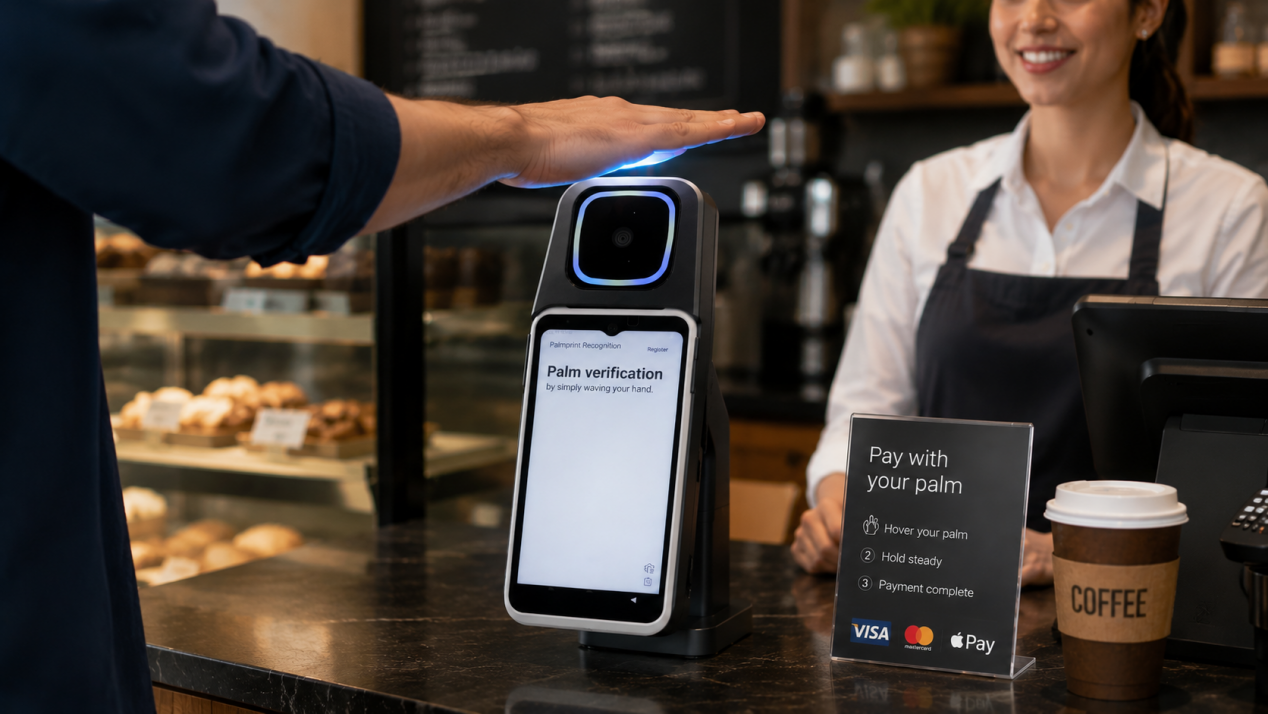
Palm vein POS terminals combine payment acceptance with biometric identity authentication. In many designs, the palm vein module works as an independent authentication component rather than as part of the payment security architecture.
This distinction is important.
If the biometric module does not:
- process EMV transactions,
- capture or process PIN data,
- access cryptographic keys,
- modify the EMV kernel,
- change the Secure Element,
- interfere with Secure Boot,
- or affect tamper protection,
then it may remain outside the certified payment security boundary.
In that case, a laboratory would usually review the architecture and determine whether any additional testing is required. This review is often referred to as a Change Impact Assessment or Engineering Change Assessment.
When Additional Testing or Certification May Be Needed
A deeper review may be required if the biometric integration touches any part of the certified payment or security environment.
This may include changes to:
- the EMV payment kernel,
- contact or contactless payment interfaces,
- secure processor,
- Secure Element,
- PIN entry path,
- cryptographic functions,
- Secure Boot,
- tamper detection mechanisms,
- or payment application architecture.
If any of these areas are affected, the lab may recommend regression testing, delta certification, or, in some cases, full re-certification.
Common Industry Practice
Payment terminal manufacturers regularly add new functions, modules, and authentication technologies to certified devices. The certification outcome is not decided simply because a biometric sensor has been added.
Instead, the modified configuration is reviewed to see whether the certified payment or security functions have changed.
This is the practical approach used across the payment industry: assess the impact first, then decide what level of testing or certification is necessary.
Practical Guidance for System Integrators
For system integrators planning to add palm vein or other biometric authentication to an EMV/PCI certified POS terminal, the best approach is to plan the architecture carefully from the beginning.
A good process is to:
- Define exactly what the biometric module does.
- Keep the biometric module outside the certified payment security boundary whenever possible.
- Make sure it does not interact with PIN, cryptographic, EMV kernel, or Secure Element functions.
- Review the architecture with an accredited EMV or PCI laboratory before deployment.
- Let the lab determine whether additional testing or certification is required.
This avoids unnecessary risk and helps prevent costly redesigns later in the project.
X-Telcom Palm Vein Payment Technology
X-Telcom develops palm vein payment technology and palm vein POS terminal solutions for payment authentication, financial services, access control, digital identity, healthcare, and smart retail applications.
Our palm vein biometric modules are designed to operate as independent identity authentication devices that complement certified payment terminals.
They authenticate users without modifying the EMV payment kernel, cryptographic functions, Secure Element, or secure payment architecture of the host terminal.
As with any change to a certified payment device, the final certification decision should always be made by an accredited EMV or PCI laboratory through a formal Change Impact Assessment.
Why Palm Vein Payment Is Gaining Attention
Palm vein technology is becoming more attractive because it offers a combination of security, convenience, and hygiene.
Compared with traditional authentication methods, palm vein recognition can provide:
- contactless user authentication,
- strong resistance to spoofing,
- stable biometric characteristics over time,
- better hygiene in public payment environments,
- and fast verification for high-volume transactions.
These advantages make palm vein POS terminals suitable for financial services, retail, healthcare, transportation, government services, and other identity-based payment scenarios.
Conclusion
Adding a biometric module, including a palm vein authentication module, to an EMV/PCI certified POS terminal does not automatically require full re-certification.
The real question is whether the integration affects the certified payment or security functions of the device.
Learn more from: https://x-telcom.com/palm-payment-terminal-airone/