
Understanding the Normal Temperature Behavior of X-Telcom Palm Vein Devices
When customers first test a palm vein recognition device, one question sometimes comes up:
“Why does the palm vein module feel warm during Palm APP continuous use?”
This is a very practical and important question. At X-Telcom, we believe customers should understand not only how palm vein recognition works, but also the real engineering logic behind the hardware.
The simple answer is:
It is normal for a palm vein module to become warm during continuous operation, because it is not just a simple camera sensor. It is a compact biometric module with active electronic components.
A Palm Vein Module Does More Than Capture an Image
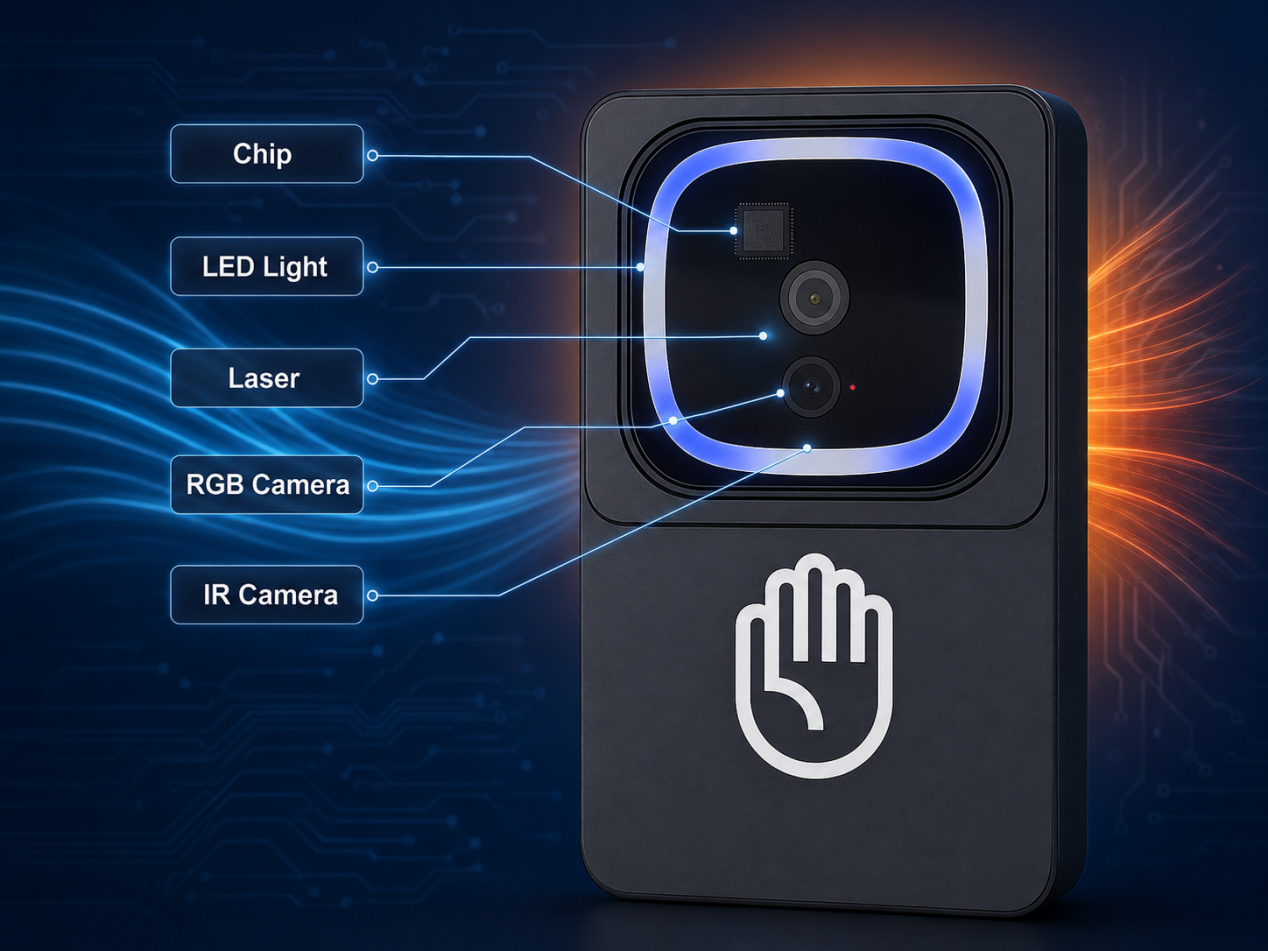
Inside an X-Telcom palm vein module, several active components work together, including:
- Chip
- LED light source
- Laser component
- RGB camera
- IR camera
These components support palm positioning, image capture, feature extraction, and biometric recognition. When the module is used continuously, these components are also continuously working.
So, just like a mobile phone or laptop becomes warm when charging or running high-performance tasks, a palm vein module may also generate heat during operation. This is a normal behavior of electronic products under workload.
Power Consumption Is One Reason for Heat Generation
X-Telcom palm vein modules are designed for reliable biometric recognition, not passive image capture only.
The typical electrical parameters include:
| Item | Specification |
|---|---|
| Operating voltage | 5V to 12V |
| Power supply current | >1.5A @ 5V |
| Average module power consumption | Around 2.5W |
This level of power consumption is reasonable for a compact biometric module with lighting, imaging, and processing components.
Without additional heat dissipation, the module temperature may reach around 70°C to 80°C, but it will normally stabilise within this upper temperature range. This does not mean the module is faulty. It means the electronic components are actively working.
How X-Telcom Manages Heat in Complete Devices
For complete devices, X-Telcom adds thermal design to help control temperature more effectively.
Normally, we use:
- Thermal silicone pads
- Metal heat sinks
- Side ventilation holes
This helps move heat away from the module and release it through the device structure.
In normal complete-device usage, the working temperature is usually around 30°C to 50°C.
In some embedded environments, such as ATM machines or self-service terminals, the module may reach around 60°C because the installation space is more enclosed. This is still within the normal and safe operating range.
Continuous App Usage Can Also Increase Device Temperature
Another point customers should understand is software workload.
If the palm recognition app is running continuously, the recognition process may consume a relatively high level of the complete device’s computing power. In some scenarios, CPU usage may reach around 70% to 80%.
When this is combined with the module’s own power consumption, the overall device temperature may naturally become higher.
This is similar to a phone running navigation, video recording, AI processing, or gaming for a long time. The device becomes warm because it is continuously processing data.
This Has Already Been Tested by X-Telcom
The temperature behavior customers may notice today is not new to us.
X-Telcom already tested this phenomenon repeatedly nearly three years ago. Based on those tests, our current complete devices have been optimised to achieve the best possible heat dissipation without increasing the device size.
For real commercial products, thermal design is always a balance between:
- Recognition performance
- Device size
- Power consumption
- Structural design
- User experience
- Long-term stability
Our goal is not only to make the device accurate and fast, but also stable and safe for real-world deployment.
Should Customers or Users Worry?
No.
Some warmth during continuous use is normal for palm vein biometric devices. The important point is whether the device has proper thermal design and whether the temperature stays within a safe operating range.
X-Telcom designs its complete devices with heat management in mind, including silicone thermal pads, metal heat sinks, and ventilation structures.
Final Thought
Palm vein recognition is not just about scanning a hand.
It is a combination of optics, lighting control, imaging, biometric processing, and hardware engineering.
So when a palm vein module becomes warm during continuous use, it is usually a sign that the system is actively working, not that the device is abnormal.
At X-Telcom, we focus on both biometric performance and real-world product reliability, because successful deployment depends on more than recognition accuracy. It also depends on stable hardware design, safe operation, and long-term trust.
X-Telcom palm vein modules may become warm during continuous use, but this is normal and safe with proper thermal design.