
The language of technology is often highly specialized. As a non-technical person, perhaps I can interpret our solution in a simpler way.
Hope this can be helpful to everyone who is caring about Palm Vein Payment Solutions. 💜 🩵
Palm Vein Payment Is Not Simply “Another NFC Payment”
In the current digital wallet payment flow, the payment card or payment token is usually presented to the POS through NFC from a mobile phone, smart watch, or wallet device.
For example, when we use a mobile wallet, the POS reads the payment token from the phone, and then the payment platform completes the transaction.
With palm vein identification, the logic is slightly different.
The POS does not directly “pull” the card information from the wallet through NFC. Instead, palm vein recognition works as an identity authentication layer.
In simple words:
The palm is used to identify who the user is.
The wallet or payment platform decides which account, wallet, or token should be charged.
A Typical Palm Vein Payment Flow
A normal palm vein payment process may work like this:
1. User Registration
During registration, the user registers their palm vein biometric data through the approved system.
This may include palm image capture, feature extraction, and quality checking to make sure the biometric registration is reliable enough for future identification.
2. Palm ID Is Linked to a Payment Account
At the same time, the user’s palm ID is linked to their wallet account, customer ID, payment account, or card token inside the bank, fintech, or digital wallet platform.
This part is usually managed by the customer’s own payment platform, not by the POS device itself.
3. Sensitive Card Information Is Not Stored in the POS
The actual card information should not be stored inside the POS device.
This is very important.
The POS terminal is mainly responsible for palm capture and communication with the biometric verification system. It should not become a place where sensitive card data is stored.
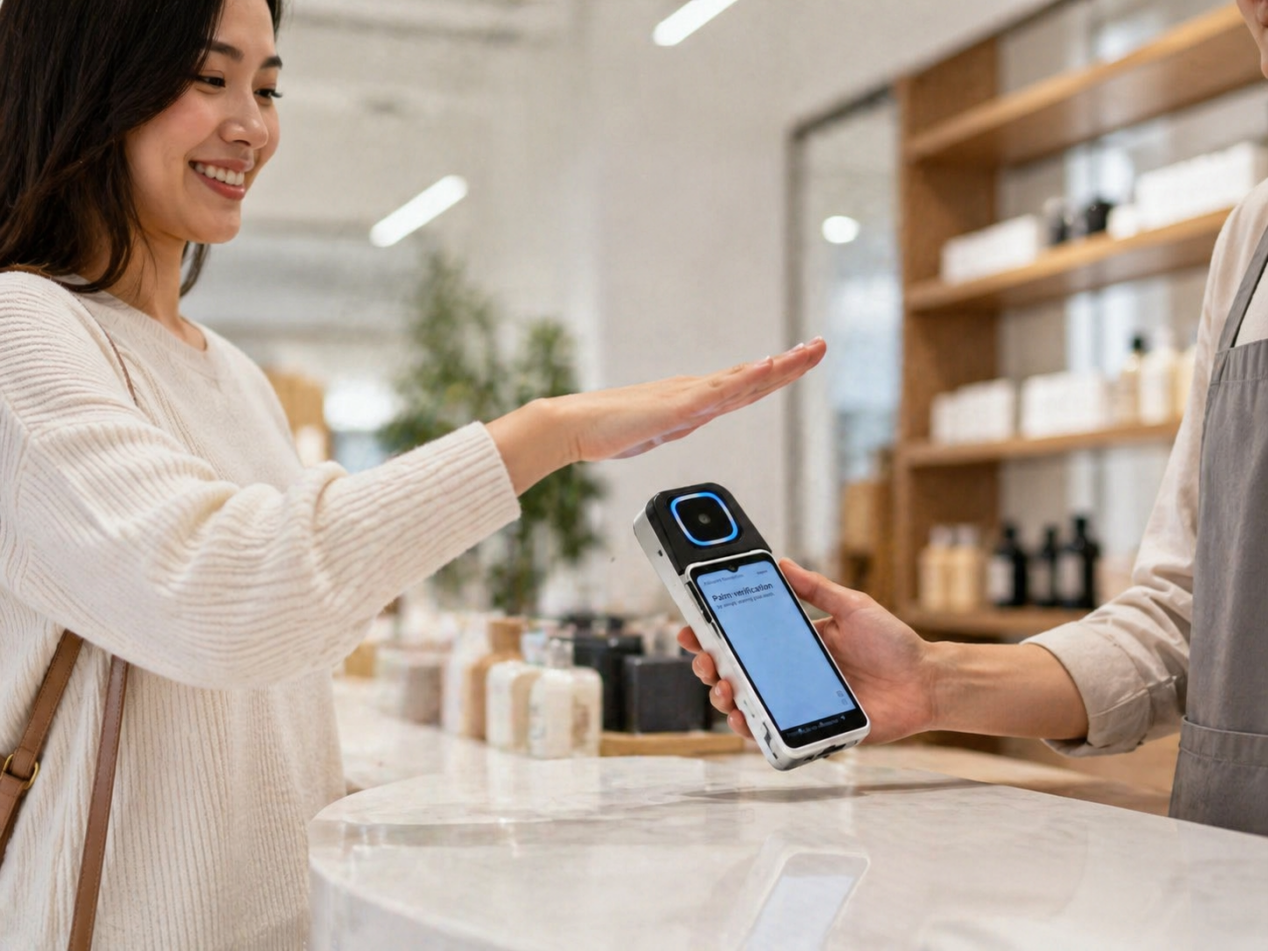
4. User Presents Palm at the POS
During payment, the user simply presents their palm above the POS or palm vein scanner.
The device captures the palm image and biometric features, then sends a verification request to the biometric matching server.
5. Biometric Matching Server Identifies the User
The biometric matching server compares the captured palm features with the registered palm database.
Once the user is identified, the system returns the corresponding user ID, wallet ID, customer ID, or token reference.
6. Wallet Platform Completes the Payment
After the user identity is confirmed, the wallet platform or payment processor completes the payment using its own stored tokenized card, wallet balance, or linked account information.
So the payment transaction is still completed by the payment platform.
The palm vein system only answers one key question:
Who is this user?
What X-Telcom / BioWavePass Provides
From our side, X-Telcom / BioWavePass provides the palm vein hardware, SDK, biometric algorithm, and integration support.
Our role is mainly focused on:
- Palm vein recognition hardware
- Palm image and feature capture
- SDK integration support
- Biometric matching algorithm
- Server-side matching support
- Technical documents for customer development teams
- Support for integration with wallet, banking, or fintech systems
The digital wallet linking, card tokenization, card storage, transaction authorization, and payment processing logic normally remain inside the customer’s own wallet, bank, or payment platform system.
This is a very important boundary.
We are not trying to replace the wallet system.
We are helping the wallet system recognize the user in a more convenient and contactless way.
Why This Architecture Is Safer
This architecture is also safer, because the POS device does not need to store sensitive card data.
The device only performs palm capture and identity verification.
The payment platform continues to control:
- Wallet account data
- Card token data
- Payment authorization
- Transaction records
- Risk control logic
- User account management
This means the customer’s bank, fintech company, or wallet platform still owns and controls the payment flow.
The palm vein system becomes an additional biometric identity layer, not a replacement for the payment platform.
Palm Vein Payment Is About Identity First
Many people may think palm payment means the palm directly becomes a bank card.
Actually, this is not the best way to understand it.
A better explanation is:
Palm vein recognition does not replace the wallet database.
Palm vein recognition does not replace card tokenization.
Palm vein recognition does not replace the payment processor.
Instead, palm vein recognition helps the payment system identify the user quickly, securely, and conveniently.
After the user is identified, the wallet or bank system decides which account should be used for payment.
Why Palm Vein Payment Can Improve User Experience
For users, the experience is very simple.
They do not need to take out a phone.
They do not need to carry a card.
They do not need to remember anything.
They only need to gently present their palm.
For merchants and payment platforms, this can create a faster and more natural checkout experience, especially in retail, smart stores, campus payment, transportation, banking, and financial inclusion projects.
Palm vein payment is not only about technology. It is also about making the payment experience easier for real people.
Final Thoughts
From our understanding, palm vein payment should be designed as a secure identity authentication layer connected with the customer’s existing wallet, banking, or payment platform.
The palm identifies the user.
The wallet platform manages the account.
The payment processor completes the transaction.
This is the architecture we believe is more practical, safer, and easier for fintech companies, banks, and digital wallet providers to adopt.
At X-Telcom / BioWavePass, we are happy to support customers with palm vein hardware, SDK, biometric algorithm, and integration documents, helping them build their own palm vein payment solution based on their existing payment ecosystem.
Palm vein payment is not about replacing the wallet.
It is about making identity verification easier, safer, and more natural.
Learn more from:
https://choosepalmveintech.com/