
As palm vein recognition technology continues to gain traction in fintech, digital identity, healthcare, and enterprise security, one question frequently comes up:
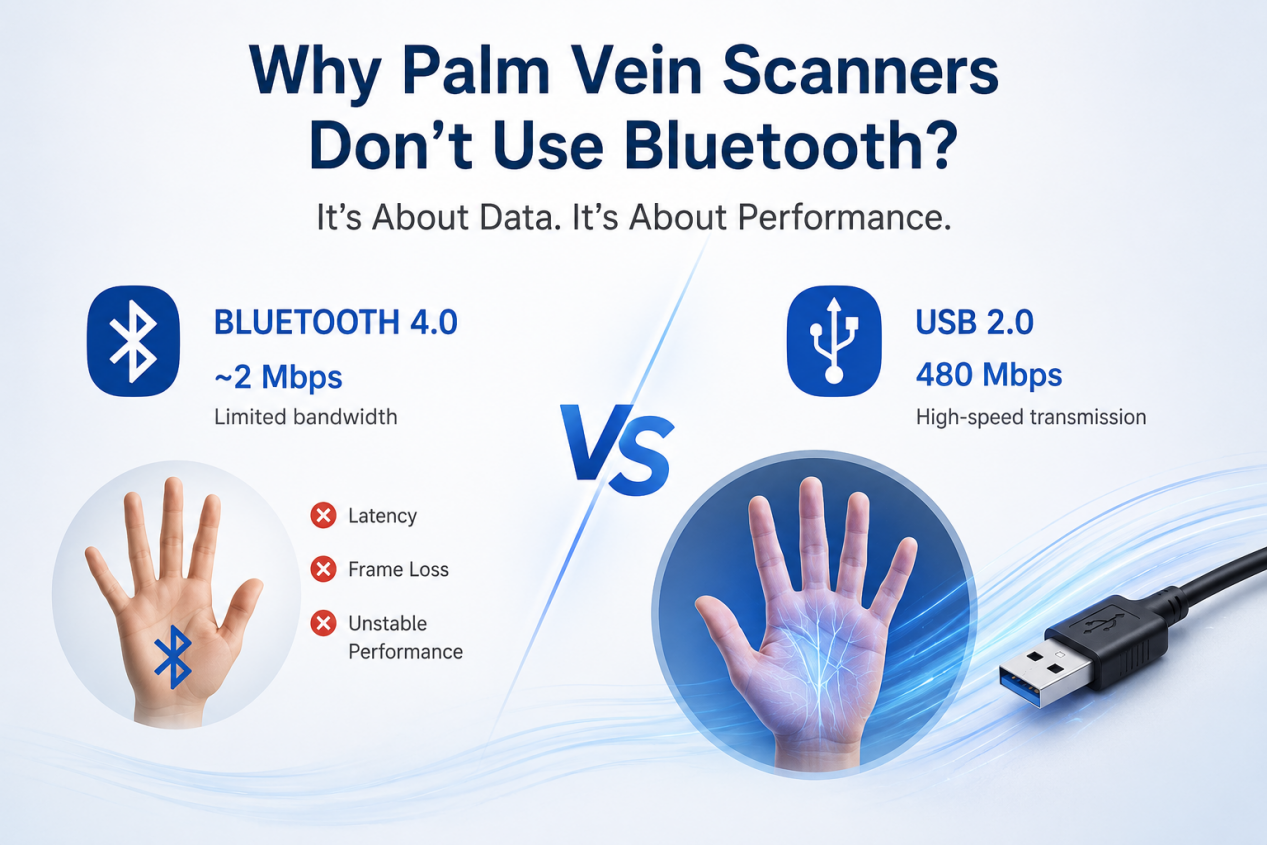
Why do most Palm Vein Scanners use USB instead of Bluetooth?
After all, Bluetooth is wireless, convenient, and widely used across countless devices. Many fingerprint scanners successfully use Bluetooth, so why not apply the same approach to palm vein recognition?
The answer lies in one often-overlooked technical factor: bandwidth.
Most fingerprint scanners perform image capture and feature extraction internally. Once the fingerprint has been processed, only a relatively small biometric template is transmitted to the host device. Since the amount of data being transferred is minimal, Bluetooth communication works well in many fingerprint applications.
Palm vein recognition is different.
Professional palm vein systems typically capture both RGB and Infrared (IR) images during every authentication process. These images are used for palm vein extraction, palm print analysis, liveness detection, and anti-spoofing verification. Rather than transmitting a simple biometric template, the system often needs to process significantly larger amounts of image data in real time.
This is where bandwidth becomes critical.
| Communication Interface | Theoretical Bandwidth |
|---|---|
| Bluetooth 4.0 | ~2 Mbps |
| Bluetooth 5.0 | Up to ~50 Mbps (ideal conditions) |
| USB 2.0 | 480 Mbps |
| USB 3.0 | 5 Gbps |
For applications that require continuous RGB and IR image transmission, USB offers a much more stable and predictable communication channel.
When bandwidth becomes constrained, several issues can occur:
- Increased authentication delays
- Frame loss during image transmission
- Reduced image quality
- Less stable recognition performance
- Inconsistent user experience
In high-security environments such as digital payments, e-KYC, banking, healthcare, and identity verification, these compromises are difficult to accept.
This is why most professional Palm Vein Scanners continue to rely on USB communication.
The decision is not simply about choosing a cable over a wireless connection. It is about ensuring that the biometric system receives high-quality image data quickly, consistently, and reliably enough to maintain accurate recognition performance.
As wireless technologies continue to evolve, future palm vein solutions may eventually support more advanced wireless implementations. However, the challenge is not transmitting biometric templates. The challenge is transmitting large volumes of image data while maintaining the speed, reliability, and security expected from modern biometric systems.
For now, USB remains the preferred choice for professional palm vein recognition deployments.
When evaluating biometric hardware, it is important to look beyond convenience and consider the underlying technical requirements. In the world of palm vein recognition, reliable image transmission is often just as important as the recognition algorithm itself.
Sometimes the most important question is not:
Can it be wireless?
But rather:
Can it be wireless without compromising performance?
For professional palm vein recognition systems, the answer today is clear: reliable real-time biometric recognition requires reliable real-time data transmission.
Learn more from: https://x-telcom.com/palm-vein-scanner/