
Understanding Palm Vein Biometric Technology
Palm vein recognition is an advanced biometric authentication technology that identifies individuals by scanning the unique vein patterns beneath the skin of the palm. Because the vein structure is internal and difficult to replicate, palm vein biometrics offer a high level of security compared with traditional identification methods such as cards, passwords, or fingerprints.
Palm vein recognition is increasingly used in industries such as:
- Financial services
- Healthcare identity verification
- Government digital ID programs
- Secure access control systems
- Payment authentication platforms
However, selecting the right palm vein biometric device depends heavily on your system architecture, deployment environment, and operational requirements.
At X-Telcom, we have developed multiple palm vein devices designed for different real-world scenarios.
Key Factors When Choosing a Palm Vein Biometric Device
Before selecting a device, developers and system integrators should evaluate several important factors.
1. Deployment Environment
Is the device going to be installed in a fixed location, or will it be used for mobile identity verification?
Some projects require biometric terminals integrated into kiosks or service counters, while others require portable devices used in field operations.
2. System Integration Requirements
Another key factor is how the biometric device will integrate with your system.
Many partners already operate their own platforms such as:
- Windows-based systems
- Linux servers
- Android terminals
In these cases, a USB palm vein scanner may be the most efficient integration option.
3. Connectivity Requirements
Different deployment environments require different connectivity options.
Some projects rely on:
- Ethernet networks
- WiFi connectivity
Others require 4G connectivity for remote verification scenarios.
4. Power Supply Stability
When using USB scanners, the stability of the host device’s USB power output is also important.
Some systems provide stable power through USB ports, while others require self-powered biometric devices to ensure consistent operation.
X-Telcom Palm Vein Devices for Different Deployment Scenarios
Based on real project requirements from partners around the world, X-Telcom has developed a complete palm vein biometric product line designed to support different integration environments.
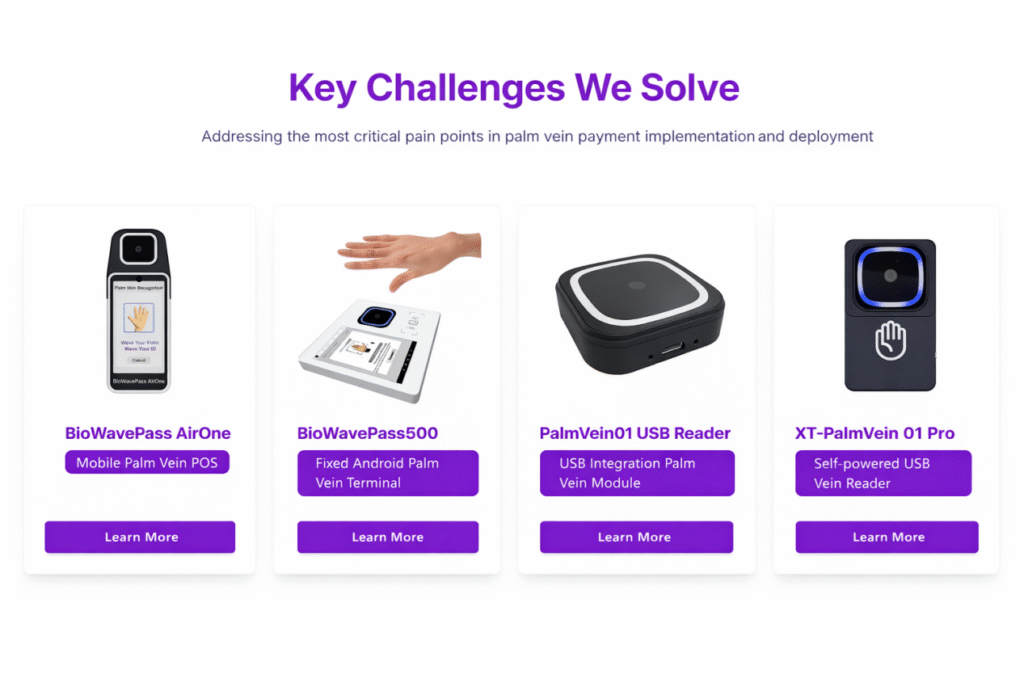
WavePass500 – Fixed Palm Vein Biometric Terminal
The WavePass500 Palm Vein Terminal is designed for fixed installations where biometric authentication is integrated directly into system infrastructure.
The device supports multiple communication interfaces including:
- WiFi
- RJ45 Ethernet
- Serial communication
- Access control interfaces
WavePass500 runs on Android, allowing developers to install their own applications and connect the terminal directly to backend systems.
Typical use cases include:
- Hospital patient check-in systems
- Self-service kiosks
- Payment terminals
- Secure access control systems
WavePass500 is ideal when a permanent biometric verification point is required.
BioWavePass AirOne – Mobile Palm Vein Verification Device
Some projects require biometric authentication outside fixed infrastructure.
For these mobile scenarios, X-Telcom developed the BioWavePass AirOne.
AirOne is a portable palm vein biometric device equipped with:
- 4G connectivity
- WiFi
- Bluetooth
- Built-in battery
These capabilities allow identity verification to be performed in mobile environments.
Common applications include:
- Mobile banking services
- Field identity verification
- Remote healthcare registration
- Government service programs
AirOne enables biometric authentication anywhere identity verification is needed.
PalmVein01 Series – USB Palm Vein Scanner for System Integration
For developers who want to integrate palm vein recognition into their existing systems, the PalmVein01 USB scanner series provides a flexible integration solution.
These scanners can connect directly to host systems such as:
- Windows computers
- Linux devices
- Android terminals
The PalmVein01 USB Palm Vein Scanner works well when the host device provides stable USB power of 5V / 1.5A or higher.
If the host USB power supply is unstable or insufficient, the PalmVein01 Pro is recommended.
PalmVein01 Pro supports self-powered operation, ensuring stable scanning performance even when USB power is limited.
Centralized Device Management for Large Deployments
For large-scale biometric deployments, centralized device management becomes essential.
Both WavePass500 and AirOne support centralized device management services.
This allows system operators to:
- Remotely update APK applications
- Monitor device health and status
- Manage multiple devices across different locations
Device management licenses are provided based on the number of deployed devices, making it suitable for scalable deployments.
Choosing the Right Palm Vein Device for Your Project
Selecting the right palm vein biometric device depends primarily on the project scenario:
- Fixed installations: WavePass500 Palm Vein Terminal
- Mobile identity verification: BioWavePass AirOne
- System integration with existing hardware: PalmVein01 USB Scanner Series
At X-Telcom, our focus is to ensure that palm vein biometric technology can be integrated easily into real-world applications.
Learn More About X-Telcom Palm Vein Solutions
To explore X-Telcom palm vein biometric devices and integration solutions, visit:
https://choosepalmveintech.com/
X-Telcom continues to develop biometric hardware designed for industries including fintech, healthcare, government identity systems, and secure authentication environments.