
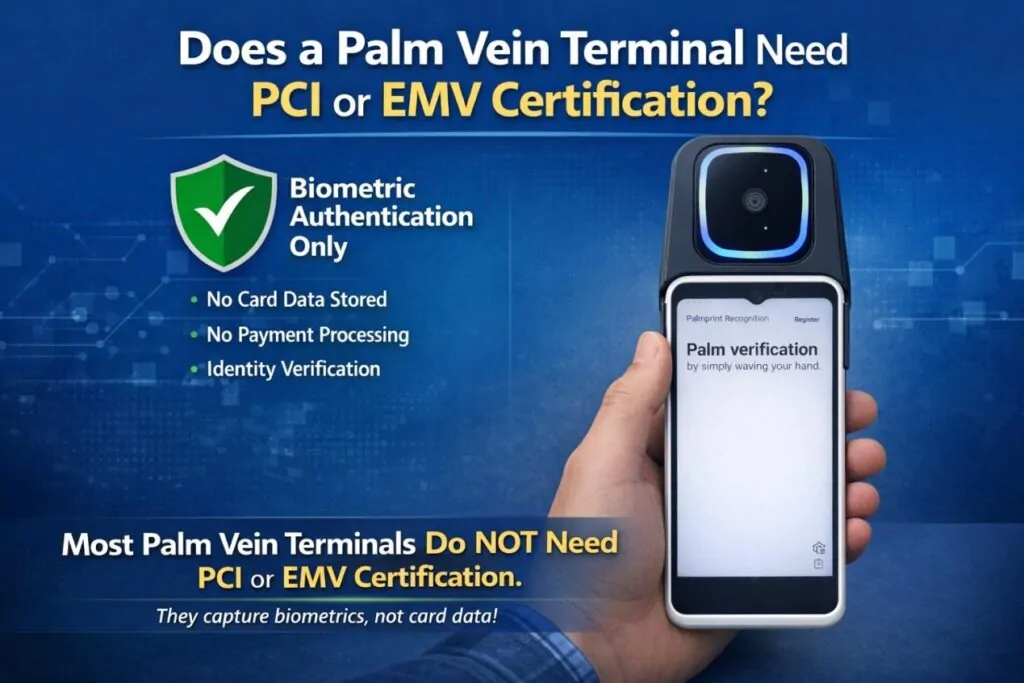
1. Do Palm Vein Terminals Need PCI or EMV Certification?
In most real-world deployments, palm vein terminals do not require PCI or EMV certification.
The reason is straightforward:
These devices do not store, process, or transmit bank card data. Their primary role is biometric identity authentication, not payment processing.
2. What Is the Role of a Palm Vein Terminal?
A palm vein terminal functions as an identity authentication layer within a broader system architecture.
Its core functions include:
- Capturing palm vein and palm print data (RGB + IR)
- Performing biometric verification
- Returning authentication results to backend systems
- Triggering actions such as payment authorization or access control
At no point does the device handle sensitive financial data.
3. Why PCI and EMV Certification Are Usually Not Required
PCI and EMV certifications apply to devices that:
- Read bank cards (chip, magstripe, NFC)
- Handle cardholder data
- Process payment credentials
- Execute financial transactions on the device
A standard palm vein terminal does none of these.
Instead, it acts as a secure biometric authentication trigger, while:
- Payment processing happens in the backend
- Tokenization is handled by the customer’s system
- Card data never passes through the biometric device
As a result, most palm vein deployments fall outside the scope of PCI/EMV requirements.
4. Architecture Matters: Identity Layer vs Payment Layer
Understanding system architecture is essential.
A typical palm vein payment system is structured as:
- Identity Layer → Palm vein authentication (device)
- Tokenization Layer → User identity linked to payment credentials
- Transaction Layer → Payment processed by backend systems
X-Telcom devices operate strictly within the identity layer, ensuring:
- No exposure to card data
- Reduced compliance complexity
- Faster deployment and scalability
5. When PCI or EMV Certification May Be Required
Certification becomes necessary only when the device integrates full payment capabilities, such as:
- Card reading (IC, NFC, magstripe)
- PIN entry
- On-device transaction processing
In these cases, the device becomes a financial payment terminal.
For such scenarios, X-Telcom also offers EMV/PCI certified palm vein devices, enabling full compliance for regulated financial environments.
6. Key Takeaway
- Most palm vein terminals do not require PCI or EMV certification
- They function as biometric authentication devices, not payment processors
- Compliance requirements depend on system architecture
- Certified device options are available when needed
7. Why X-Telcom?
X-Telcom delivers flexible palm vein hardware solutions designed for global deployment:
- RGB + IR dual-mode biometric capture for higher accuracy
- Recognition speed as fast as 0.35 seconds at large scale
- Support for millions of user IDs in large databases
- AES-256 encryption with data stored only on customer-owned servers
- SDK/API support for seamless integration
- Optional EMV/PCI certified devices for payment scenarios
Final Note
With the right system architecture, businesses can:
- Reduce compliance burden
- Accelerate deployment timelines
- Build scalable and secure biometric ecosystems
Palm vein technology is not just about identification.
It is about creating a future-ready identity infrastructure.
Learn more:
https://x-telcom.com/palm-vein-reader/