
Introduction
As biometric projects move from pilot stage to real-world deployment, many businesses discover that success depends on more than just a device.
The real question is:
What kind of platform can support biometric authentication from MVP to millions of users without rebuilding the whole system?
This is where a Palm Vein Technology Platform becomes essential.
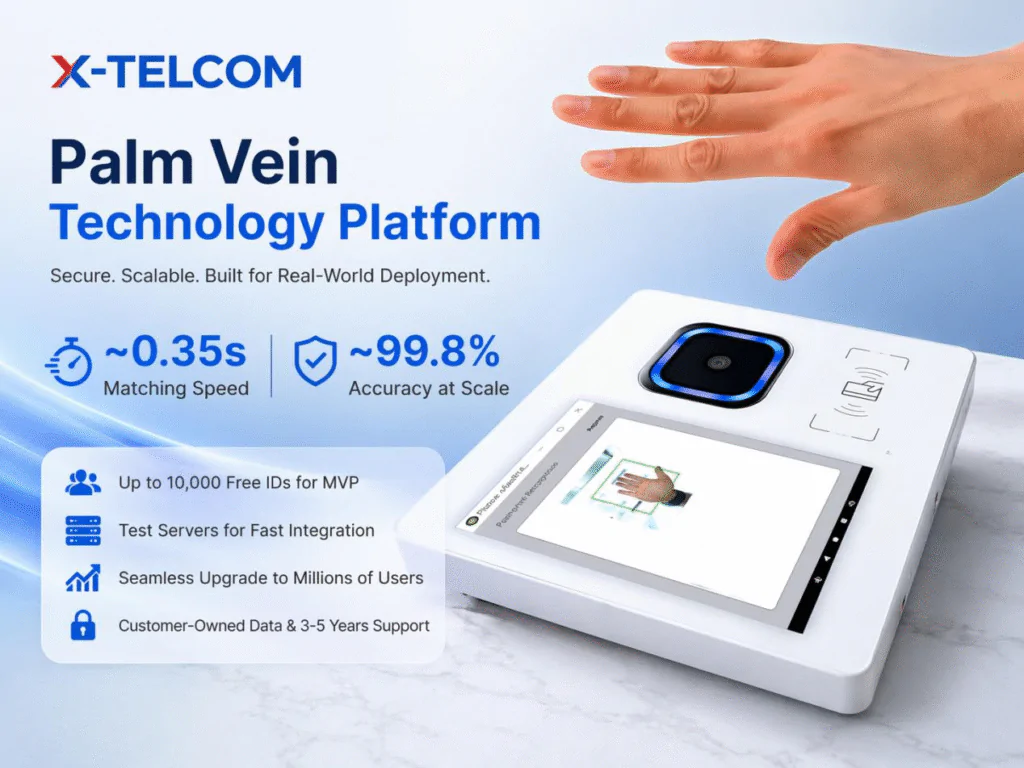
At X-Telcom, palm vein technology is not positioned as a single hardware product. It is designed as a complete biometric platform, combining hardware, algorithm, licensing, and scalable infrastructure into one deployable system.
What Is a Palm Vein Technology Platform?
A palm vein technology platform is a complete biometric system built for secure identity authentication at scale.
It typically includes:
- Hardware for palm data capture
- Algorithm for feature extraction and matching
- Backend infrastructure for database comparison and system expansion
This makes it suitable for:
- Payment systems
- eKYC onboarding
- Government identity projects
- Enterprise authentication platforms
In other words, the platform is not just about scanning a palm. It is about creating a biometric architecture that can grow with the project.
Why a Platform Approach Matters
Many biometric deployments fail to scale because they start with a device-first mindset rather than a system-first architecture.
At small scale, a basic biometric setup may appear sufficient. But as the project grows, several issues begin to appear:
- User databases get larger
- Matching speed slows down
- Integration becomes more complex
- Licensing becomes unclear
- Upgrades create disruption
A platform approach solves this by planning for:
- Scalability
- upgradeability
- predictable licensing
- long-term ownership
The Core Architecture of a Palm Vein Technology Platform
A scalable palm vein system is typically built on four layers.
1. Device Layer
This is where biometric data is captured.
The system uses:
- RGB imaging for surface palm features
- IR imaging for internal vein structure
- Liveness detection for stronger security
This dual-mode capture provides richer biometric data than single-source systems.
2. Algorithm Layer
The algorithm layer is responsible for:
- Feature extraction
- Identity matching
- large-scale comparison logic
This is the intelligence core of the system.
In a well-designed platform, the algorithm supports both:
- early-stage deployment
- future large-scale expansion
3. Data Layer
The platform is designed to work with:
- feature vector-based matching
- image-based re-extraction support
This is important because day-to-day recognition can use feature vectors for speed, while stored RGB and IR images can support future algorithm upgrade and feature reprocessing.
4. Infrastructure Layer
For large-scale deployment, the platform uses:
- GPU-based computing
- vector database architecture such as Milvus
- scalable backend services
This ensures the system can handle high concurrency and large user volumes without losing speed or stability.
Real Performance at Scale
A palm vein technology platform must prove itself under real deployment conditions, not just in theory.
X-Telcom’s large-scale algorithm capability is designed for high-volume biometric environments, with performance targets such as:
- ~0.35 seconds matching speed
- ~99.8% accuracy in large-scale environments
This level of performance is essential for systems where real-time authentication matters, such as:
- payment verification
- identity onboarding
- access control
- public service authentication
The Role of ID-Based Licensing
One of the most important parts of a scalable platform is the licensing model.
X-Telcom uses an ID-based algorithm license model.
This means:
- each registered user occupies one ID
- the total license defines the system capacity
- if one user is deleted, that ID is released and can be reused
This model is very different from systems that charge per transaction or per API call.
Why this matters
It gives customers:
- predictable cost structure
- efficient license utilization
- a clear path for future scaling
The core logic is simple:
You do not scale by transactions. You scale by users.
From MVP to Large Scale
A strong biometric platform must support growth without forcing the customer to rebuild from the beginning.
MVP Stage
For early projects, the platform can start with:
- limited deployment
- pilot users
- fast testing and integration
X-Telcom supports this stage with:
- up to 10,000 free ID licenses for MVP use
- a lower barrier to initial validation
- a practical entry point for development teams
Large-Scale Stage
As the system grows beyond 10,000 user IDs:
- additional licenses are purchased
- infrastructure can be scaled
- the system expands to support 100K to millions of users
This allows the customer to grow in stages instead of overcommitting too early.
Development and Testing Support
Another key part of a real platform is the development environment.
After sample purchase, X-Telcom provides:
- small model test server
- large scale algorithm test server
- API access for integration
- real-time debugging environment
This matters because customers do not want to buy hardware and then guess how the backend will behave.
Instead, they can:
- test integration early
- validate architecture
- compare small and large model logic
- reduce project risk before full rollout
Seamless Upgrade Without Rebuilding
A major concern in biometric projects is what happens when the system must scale or the model must change.
A strong platform should allow:
- no SDK rebuild
- no application redesign
- no forced disruption to the customer’s workflow
X-Telcom supports upgrade paths such as:
- incremental upgrade API
- re-uploading stored images when needed
The key requirement is simple:
👉 RGB + IR images must be stored for future feature re-extraction
As long as this is planned correctly, growth can happen far more smoothly.
Customer Ownership Matters
For enterprise and government customers, technology capability is only part of the decision.
Ownership and control matter just as much.
X-Telcom’s platform is designed so that:
- the system is deployed on customer-owned servers
- biometric data remains under customer control
- daily operation does not depend on X-Telcom
At the same time, X-Telcom provides:
- 3 to 5 years of algorithm support
This gives customers a balance of:
- long-term technical confidence
- operational independence
- reduced vendor lock-in concerns
Why This Platform Model Makes Sense
Compared with fragmented biometric solutions, a platform model offers several advantages:
- clearer scaling path
- cleaner system architecture
- better cost predictability
- stronger control over data and deployment
- lower risk when moving from pilot to production
Instead of solving isolated problems one by one, the platform solves them as part of a single system strategy.
Conclusion
A Palm Vein Technology Platform is not just a scanner, and not just an algorithm.
It is a scalable biometric infrastructure built to support real projects from pilot stage to large deployment.
At X-Telcom, this platform approach combines:
- dual-mode biometric capture
- scalable matching architecture
- ID-based licensing
- development test environment
- upgrade-ready system design
- customer-controlled deployment
Final Thought
If a biometric project is expected to grow, the platform behind it must be designed for growth from the beginning.
That is what makes a palm vein technology platform different from a standalone biometric device.
CTA
If you are planning a biometric project and need a system that can move from testing to large-scale deployment with a clear upgrade path:
👉 Learn more: https://x-telcom.com/palm-vein-reader/