
Introduction
As biometric systems evolve from pilot projects to nationwide and enterprise-grade deployments, one critical question arises:
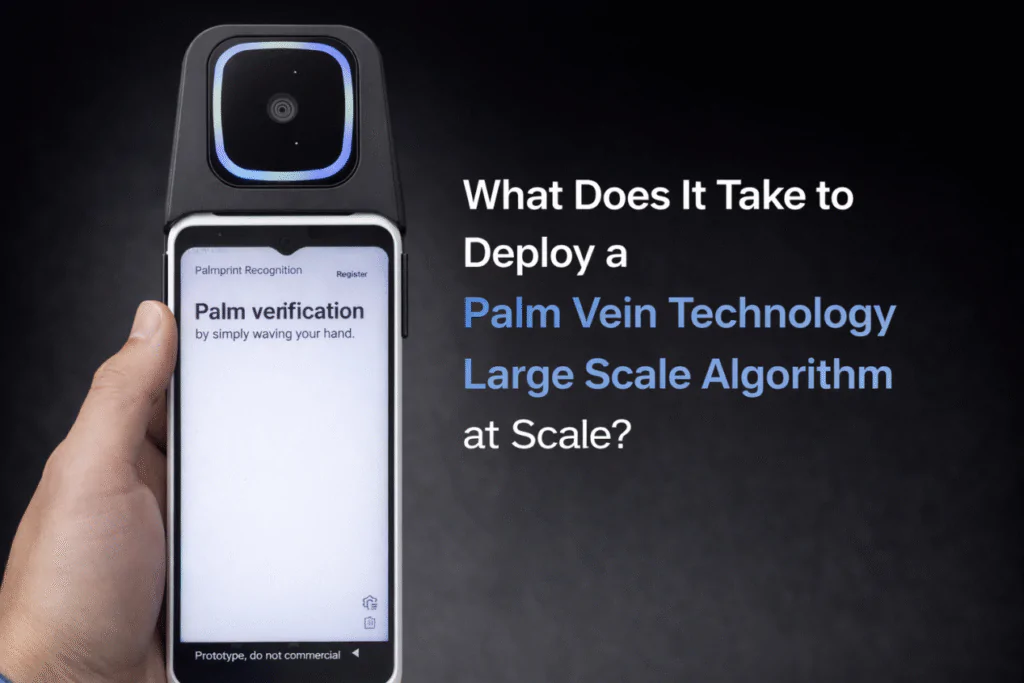
What does it actually take to deploy a palm vein technology large scale algorithm at scale?
It is not just about having a device or an algorithm.
A successful large-scale deployment requires a complete system architecture, including hardware, algorithm, infrastructure, and data strategy.
Beyond Devices: The Reality of Large-Scale Deployment
Many assume that deploying biometric systems is straightforward:
- Install devices
- Connect to a database
- Start authentication
However, at scale, the complexity increases significantly:
- Millions of user records
- High concurrent authentication requests
- Real-time performance expectations
- Long-term system stability
Without the right architecture, systems quickly face:
- Latency issues
- Accuracy degradation
- System bottlenecks
Core Requirements for Large-Scale Deployment
1. High-Quality Data Acquisition (RGB + IR)
A scalable system starts with high-quality input data.
Palm vein systems must capture:
- RGB images → surface palm features
- IR images → subdermal vein patterns
This dual-mode approach ensures:
- Rich feature extraction
- Higher matching reliability
- Stability across large datasets
2. Device-Side SDK Integration
The device is not just a scanner, but part of the algorithm pipeline.
The SDK is responsible for:
- Palm image acquisition
- Liveness detection
- Feature vector extraction
Without proper SDK integration:
- Data quality becomes inconsistent
- Algorithm performance drops
- Large-scale accuracy cannot be maintained
3. Algorithm Deployment Model (API-Based Architecture)
At scale, the algorithm is deployed as a server-side service.
Key characteristics:
- Communication via HTTP API
- Centralized matching engine
- Device-to-server interaction
Important considerations:
- Algorithm is provided as a deployment package (not source code)
- API protocols are predefined
- Customization requires evaluation and depends on project scale
4. GPU-Based Computing Infrastructure
Large-scale biometric matching cannot rely on CPU-only systems.
A typical deployment includes:
- GPU acceleration (e.g., NVIDIA A10)
- Parallel processing capabilities
- Scalable compute nodes
Why GPU matters:
- Enables simultaneous processing of multiple requests
- Reduces matching time
- Maintains performance under high concurrency
5. Vector Database Architecture (Milvus)
Traditional databases are not suitable for biometric matching.
A large-scale system requires:
- Vector-based storage for feature data
- High-speed similarity search
- Efficient indexing
Milvus provides:
- Stable performance at million-level scale
- Fast query response
- Support for concurrent operations
Real Testing Data from Large-Scale Deployment
To validate system performance, internal testing was conducted under real-world conditions.
Test Setup
- Database size: 5 million users
- Concurrency: 100,000 parallel operations per task (registration / deletion / query)
- Hardware: NVIDIA A10 GPU
- Architecture: GPU + Milvus vector database
Key Results
1. Response Time
- Average query time: ~300 milliseconds
- Stable performance under high load
2. System Stability
Under simultaneous operations:
- Enrollment
- Deletion
- Identification
The system maintained:
- No performance degradation
- No blocking or system lag
- Consistent response time
3. Scalability
- Supports high TPS/QPS scenarios
- Easily expandable with additional GPU nodes
- Suitable for million-level and beyond deployments
4. Accuracy at Scale
With a 5 million user database:
- Recognition success rate reaches ~99% level
- Maintains high accuracy even under large-scale conditions
Key reasons:
- Dual-mode RGB + IR data
- Multi-layer verification
- High-quality feature extraction
System Architecture Overview
A scalable palm vein system typically includes:
Device Layer
- Image capture (RGB + IR)
- Liveness detection
- Initial feature extraction
Algorithm Layer
- Feature reprocessing
- High-speed matching
Data Layer
- Vector storage (Milvus)
- Efficient retrieval
Infrastructure Layer
- GPU servers
- Load balancing
- Horizontal scaling
Key Considerations Before Deployment
Before deploying at scale, organizations must evaluate:
- Expected number of users (e.g., 100K vs 5M vs 50M)
- Concurrent authentication volume (TPS/QPS)
- Hardware infrastructure (GPU capacity)
- Network performance
- Data storage strategy
Each factor directly impacts:
- System performance
- Cost efficiency
- Long-term scalability
Why Architecture Matters More Than Algorithm Alone
A powerful algorithm alone is not enough.
At scale, success depends on:
- Data quality
- System architecture
- Infrastructure design
- Integration strategy
Only when all components work together can the system achieve:
- Real-time performance
- High accuracy
- Long-term stability
Conclusion
Deploying a palm vein technology large scale algorithm at scale requires more than technology,
it requires a complete, well-designed ecosystem.
From device to GPU infrastructure, from SDK to vector database,
every layer plays a critical role.
With validated performance at:
- 5 million user scale
- 100,000 concurrent operations
- ~300ms response time
Palm vein technology is ready for real-world, large-scale deployment.
CTA
If you are planning a large-scale biometric or payment system,
a properly designed palm vein architecture can deliver both scalability and reliability.
👉 Learn more: https://x-telcom.com/palm-vein-reader/