
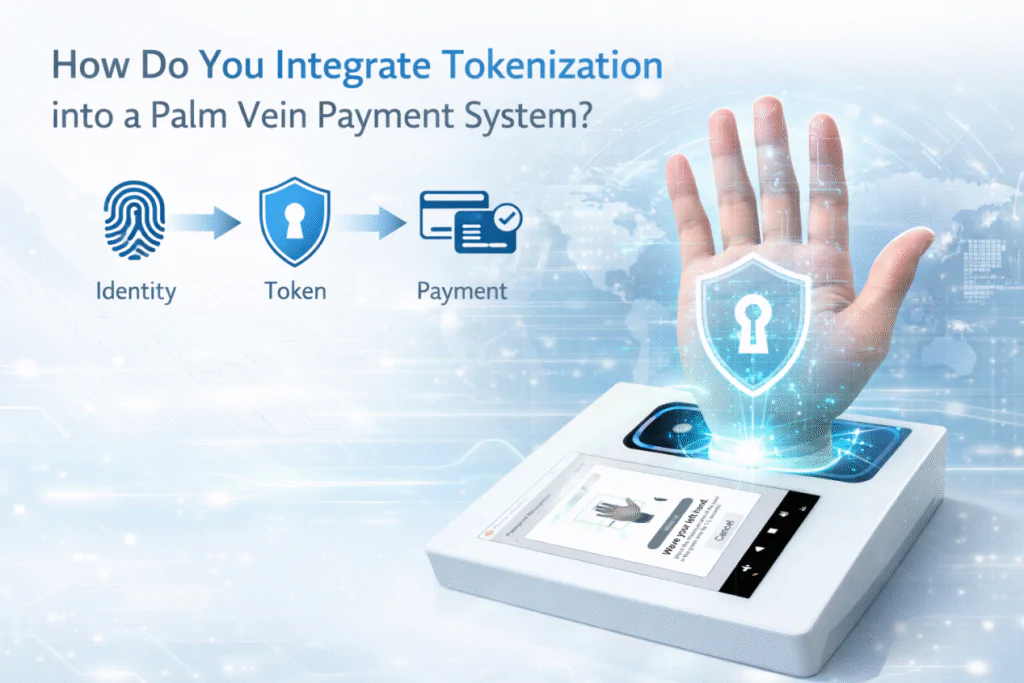
As palm vein payment gains traction across fintech, banking, and public-sector projects, one key technical question continues to surface:
How do you actually integrate tokenization into a palm vein payment system?
While palm vein recognition provides a secure way to verify identity, a complete payment solution requires more than biometrics. It must connect identity to financial transactions through a well-defined architecture.
Understanding the Integration Challenge
Many assume that biometric providers also deliver tokenization and payment systems. In reality, these are separate layers that must be integrated correctly.
A complete palm vein payment system includes:
- Identity Layer (Biometric Recognition)
- Tokenization Layer (Authorization)
- Transaction Layer (Payment Processing)
Integration is about connecting these layers seamlessly, not merging them into one.
Step 1: Integrate the Identity Layer
The first step is to establish a reliable biometric identity system.
X-Telcom provides the identity layer, including:
- RGB + IR palm vein data capture
- Liveness detection
- Feature extraction and vector generation
- High-speed matching across large-scale databases
- Cloud or local verification options
All palm vein data and images are encrypted using AES-256 and stored only on the client’s own server or cloud infrastructure. X-Telcom does not participate in data management.
Output of this layer:
👉 A verified identity (Palm ID)
Step 2: Connect Identity to Tokenization
Once identity is verified, the system must translate it into a usable payment credential.
This is where integration becomes critical.
Your tokenization system should:
- Receive Palm ID from the biometric layer
- Generate a secure Payment Token
- Bind the token to:
- A wallet
- A bank account
- Or a payment profile
Integration requirements:
- API interface between biometric system and token server
- Secure mapping logic (Palm ID → Token)
- Token lifecycle management
Step 3: Integrate with Payment Systems
The token must then be accepted by your payment infrastructure.
This involves:
- Connecting to payment gateways
- Integrating with banking systems
- Supporting wallet-based transactions
At this stage:
👉 The Token becomes the only credential used in transactions
No biometric or financial data is directly exposed.
End-to-End Integration Flow
A typical integrated system works as follows:
- User scans palm
- X-Telcom verifies identity
- Palm ID is generated
- Tokenization system maps Palm ID to Token
- Token is passed to payment system
- Transaction is executed
Key Design Principles
1. Separation of Layers
Do not combine:
- Biometric processing
- Tokenization
- Payment execution
Each layer should remain independent but connected.
2. Secure Data Handling
- Biometric data stays within the identity system
- Token replaces sensitive data in transactions
- Financial data remains within payment systems
3. API-Driven Architecture
All integrations should be handled via:
- Secure APIs
- Standardized data formats
- Scalable backend services
X-Telcom’s Role in Integration
It is important to clearly define responsibilities.
What X-Telcom Provides
- Biometric identity layer (palm vein recognition)
- Device hardware and SDK
- Algorithm and matching engine
- Integration support
What X-Telcom Does Not Provide
- Tokenization systems
- Payment processing systems
- Financial transaction handling
What We Support
- Tokenization integration design
- API and SDK guidance
- Palm ID to Token mapping strategy
- Payment system integration support
Common Integration Mistakes to Avoid
- Assuming biometric systems handle payments
- Mixing identity and financial data flows
- Storing sensitive data in multiple systems
- Skipping tokenization design
Conclusion
Integrating tokenization into a palm vein payment system is not about adding a feature—it is about building a modular, secure architecture.
X-Telcom delivers a high-performance identity layer, enabling partners to integrate tokenization and payment systems in a flexible and compliant way.
Learn More From: https://x-telcom.com/palm-vein-reader/
In palm vein payment, identity is the foundation,
tokenization is the bridge, and payment is the execution.