
As palm vein payment technology gains global attention, more fintech companies, banks, and solution providers are exploring how to integrate biometric authentication into their payment ecosystems.
One of the most frequently asked questions is:
What exactly is tokenization in palm vein payment—and who is responsible for it?
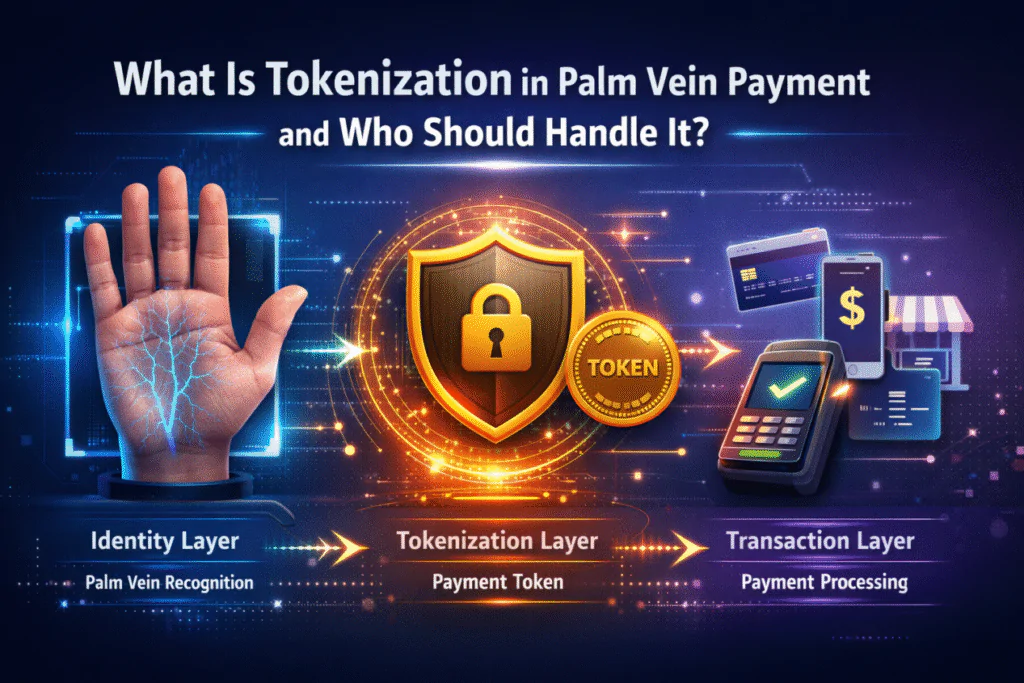
Understanding this is critical, because many assume that biometric device providers also handle payment logic. In reality, palm vein payment is built on a layered architecture, where each component has a clearly defined role.
What Is Tokenization in Palm Vein Payment?
Tokenization is the process of converting sensitive information into a non-sensitive, non-reversible identifier (Token) that can be safely used in transactions.
In the context of palm vein payment:
- Palm vein recognition → confirms identity
- Identity (Palm ID) → is converted into a Payment Token
- Token → is used to initiate and complete transactions
👉 This means:
- No biometric data is used in the payment process
- No financial data is exposed during transactions
- The Token acts as a secure bridge between identity and payment
Why Tokenization Is Essential
1. Protecting Biometric Data
Biometric data, such as palm vein patterns, is permanent and cannot be changed.
Tokenization ensures:
- Biometric data is never exposed in transaction flows
- Even if systems are compromised, no usable data is leaked
2. Enabling Secure Payments
Instead of using:
- Bank account numbers
- Card details
The system uses:
👉 Tokens that have no intrinsic value outside the payment system
3. Supporting Compliance
Tokenization helps meet global compliance requirements, including:
- PCI DSS
- GDPR
- Local data protection laws
Because:
- Sensitive data is isolated
- Merchants never handle real financial credentials
The Three-Layer Architecture of Palm Vein Payment
To fully understand who handles tokenization, we must first understand the system architecture.
1. Identity Layer — Provided by X-Telcom
This is where palm vein recognition happens.
X-Telcom provides:
- RGB + IR palm vein capture
- Liveness detection
- Feature extraction
- High-speed matching (million-level databases)
- Cloud or local verification options
All palm vein data is encrypted using AES-256 and stored only on the client’s own server infrastructure. X-Telcom does not participate in data management.
Output:
👉 Verified user identity (Palm ID)
2. Tokenization Layer — Handled by the Client
This layer is responsible for converting identity into a usable payment credential.
It performs:
- Palm ID → Token mapping
- Binding Token to:
- Wallets
- Bank accounts
- Payment credentials
Key characteristics:
- Tokens are non-reversible
- No biometric or financial data is embedded
- Tokens are used for all payment operations
3. Transaction Layer — Payment Systems
This is where actual financial transactions take place.
Using the Token:
- Payment requests are initiated
- Transactions are processed
- Funds are settled
This layer typically includes:
- Payment gateways
- Banking systems
- E-wallet platforms
Who Should Handle Tokenization?
👉 Tokenization should be implemented by:
- Payment platforms
- Fintech companies
- Banks or wallet providers
Not by biometric hardware or algorithm providers.
X-Telcom’s Role in Tokenization Projects
It is important to clearly define the boundary.
What X-Telcom Does
- Provides the biometric identity layer
- Delivers palm vein recognition devices and algorithms
- Outputs Palm ID after successful authentication
What X-Telcom Does Not Do
- Does not build tokenization systems
- Does not process payments
- Does not manage financial transactions
How X-Telcom Supports You
Although we do not directly provide tokenization, we support:
- Joint development of tokenization architecture
- API and SDK integration guidance
- Palm ID to Token mapping design
- Integration with payment platforms and banking systems
End-to-End Payment Flow
A complete palm vein payment process looks like this:
- User scans palm
- X-Telcom system verifies identity
- Palm ID is generated
- Client system converts Palm ID into a Token
- Token is used to initiate payment
- Transaction is completed
👉 At no point is biometric data used in the payment transaction itself
Key Takeaway
The most important concept to understand is:
Your palm is not your payment — your token is.
Palm vein recognition answers:
👉 Who you are
Tokenization defines:
👉 What you are allowed to do
Payment systems execute:
👉 The transaction itself
Conclusion
Tokenization is the critical bridge between biometric identity and financial transactions in palm vein payment systems.
X-Telcom focuses on delivering a secure, high-performance identity layer, while enabling clients and partners to build and control their own tokenization and payment infrastructure.
This clear separation ensures:
- Stronger security
- Better compliance
- Greater flexibility
Final Thought
X-Telcom focuses on who you are —
Tokenization and payment define what you can do.
Learn more from: https://choosepalmveinpay.com/