
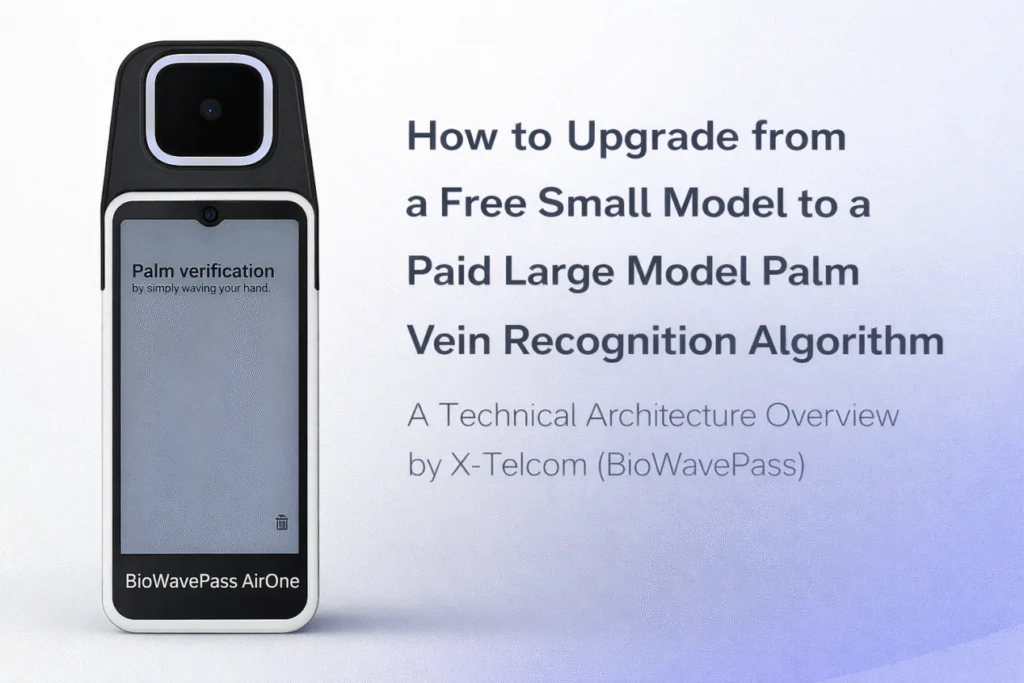
As biometric deployments scale, algorithm evolution becomes inevitable.
At X-Telcom, many partners begin their systems using a small model palm vein recognition algorithm during development or pilot phases.
When deployments expand or require higher recognition accuracy, upgrading to a large model palm vein recognition algorithm becomes the natural next step.
From the perspective of an X-Telcom algorithm engineer, the key to a smooth upgrade is not just the algorithm itself but how the biometric data architecture is designed from the beginning.
If the system stores the right biometric data during registration, upgrading the algorithm can be completed without requiring users to re-register their palms.
Understanding the Small Model Palm Vein Recognition Algorithm
During early deployment stages, the small model algorithm provides a lightweight verification architecture.
In this model, recognition relies primarily on device-side feature extraction.
Typical workflow:
- The X-Telcom palm vein device captures RGB and IR palm data
- The SDK extracts two biometric features:
- RGB Palm Print Feature
- IR Palm Vein Feature
- The feature vectors are transmitted to the application server
- The server compares the features with stored user data
This architecture allows developers to integrate biometric authentication quickly while keeping server-side resources minimal.
Because the small model uses only feature vectors, image data is not required for matching at this stage.
Why X-Telcom Recommends Storing Palm Images Early
Although the small model does not require image comparison, the X-Telcom algorithm team strongly recommends storing RGB and IR palm images during user registration.
Each registered hand typically produces:
- 1 RGB palm image
- 1 IR palm vein image
The SDK includes built-in quality verification during the registerPalm process, ensuring that only images meeting the required quality standards are saved. :contentReference[oaicite:0]{index=0}
From an algorithm engineering perspective, storing images provides several long-term advantages:
- Enables seamless upgrades to advanced AI models
- Prevents costly user re-registration campaigns
- Preserves original biometric data for algorithm improvements
- Supports higher accuracy verification in large databases
If palm images are not stored during registration, upgrading to future AI algorithms may require collecting biometric data again from all users.
How the Large Model Palm Vein Recognition Algorithm Works
When deployments grow or higher security is required, the large model palm vein recognition algorithm becomes the preferred architecture.
Unlike the small model, the large model performs multi-layer biometric verification.
The algorithm uses four verification elements:
- Device-side RGB palm print feature
- Device-side IR palm vein feature
- Server-side palm print feature extracted from stored RGB images
- Server-side palm vein feature extracted from stored IR images
The server-side AI algorithm re-extracts biometric features directly from stored images and combines them with device-side features.
This multi-layer verification significantly improves:
- Recognition accuracy
- Anti-spoofing capability
- Large-scale database performance
Because the system retains the original biometric images, the algorithm can continue evolving without requiring users to re-register. :contentReference[oaicite:1]{index=1}
Upgrading from Small Model to Large Model
One of the core design principles of the X-Telcom palm vein platform is smooth algorithm upgradeability.
The typical upgrade process includes:
- Deploying the large model algorithm service on the customer’s server
- Configuring the algorithm service according to deployment documentation
- Updating the application server API endpoint
- Performing minor interface adaptation if required
Since the biometric database already contains the necessary data, the system can begin operating with the large model immediately after deployment.
Most upgrades involve only minimal integration work on the application server.
Recommended Data Structure for Scalable Palm Vein Systems
To ensure future scalability, X-Telcom recommends storing the following data for each user:
- User ID or phone number
- RGB palm image
- IR palm image
- RGB palm feature vector
- IR palm vein feature vector
For deployments with 10,000 users or fewer, storing feature vectors may be technically sufficient for the small model.
However, storing RGB and IR images is still strongly recommended so that when the system upgrades to the large model later, existing users will not need to register again.
For deployments exceeding 10,000 users, storing both images and feature vectors is essential to support large-scale AI verification and optimal accuracy. :contentReference[oaicite:2]{index=2}
Designing Palm Vein Systems That Can Evolve
From the perspective of an algorithm engineer, the most important principle in biometric architecture design is future readiness.
Palm vein recognition technology will continue improving as AI models evolve.
By storing biometric images during registration and designing the system architecture correctly from the start, organizations gain the ability to:
- Upgrade algorithms without interrupting users
- Improve recognition accuracy as AI models advance
- Scale systems from pilot projects to national-level deployments
At X-Telcom, our goal is to build palm vein recognition systems that are secure, scalable, and continuously upgradeable.
Learn more about X-Telcom palm vein solutions: https://x-telcom.com/palm-vein-reader/