
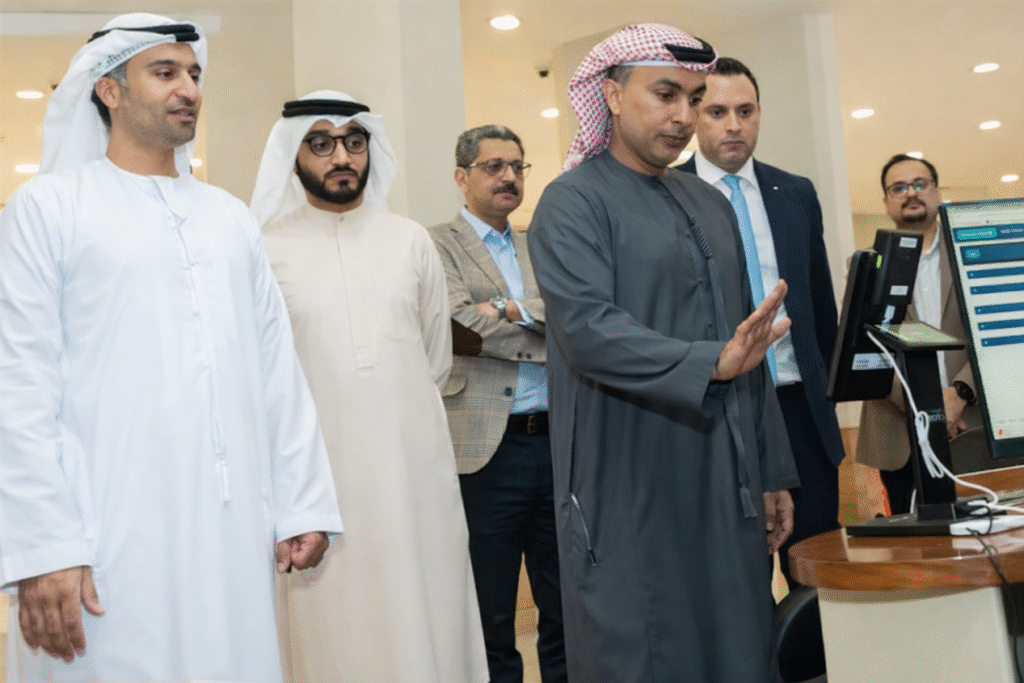
The recent announcement that the UAE Central Bank has launched the Middle East’s first central bank–led biometric payment proof of concept marks an important milestone for the region’s payment ecosystem.
Unlike many retail-led biometric experiments, this initiative is being conducted within a regulatory sandbox, with direct involvement from payment processors and biometric technology providers. It signals that biometric payments are moving from isolated commercial trials into a regulator-validated phase.
For X-Telcom, this development strongly reinforces the direction we have taken with palm vein technology.
From “Can It Work?” to “Can It Be Governed?”
For years, biometric payments have focused on feasibility and user experience. The UAE pilot represents a clear shift in emphasis.
Central banks are no longer asking whether biometric payments are technically possible. They are asking whether these systems can be secure, auditable, scalable, and compliant within national payment infrastructures.
This distinction is critical. A payment-grade biometric system must meet requirements far beyond those of access control or attendance use cases. It must support large user populations, integrate with existing payment and wallet platforms, and operate within clearly defined data governance boundaries.
Why Palm Vein Technology Fits Regulatory-Grade Payments
The UAE pilot highlights a growing regulatory preference for palm-based biometrics, often used alongside facial recognition rather than replaced by it.
Palm vein technology offers several characteristics that align well with central bank and government requirements:
- Non-contact authentication suitable for high-frequency public use
- Stable biometric features that are difficult to spoof
- Strong performance across diverse user groups, including elderly users
- Clear separation between biometric authentication and payment processing logic
For regulators, this combination provides a balance between usability, security, and risk management.
X-Telcom’s Focus: Payment-Grade, Large-Scale Deployments
At X-Telcom, our palm vein solutions are designed specifically for large-scale authentication, e-KYC, and palm vein payment projects.
We do not position palm vein technology as a replacement for existing payment systems. Instead, it is designed as a biometric authentication layer that integrates with:
- Existing POS systems
- Digital wallets and payment platforms
- e-KYC and identity verification workflows
This approach closely mirrors what regulators are validating through sandbox programmes: innovation that works with the existing financial infrastructure, not against it.
Data Ownership and Compliance as Core Design Principles
One of the strongest signals from the UAE pilot is the emphasis on governance.
In payment and government projects, biometric data ownership is not negotiable. That is why X-Telcom’s palm vein technology is built around a clear principle:
- All biometric data is stored on customer-controlled local servers or customer cloud environments
- X-Telcom does not store, access, or manage customer biometric data
- Encryption is applied in transmission and at rest to support financial and government compliance
This architecture aligns closely with the expectations of central banks and public-sector stakeholders.
What This Means for the Middle East Market
The UAE initiative is likely to influence how biometric payment projects are evaluated across the region, including Saudi Arabia and other Gulf markets.
We expect to see:
- More regulator-led or regulator-approved pilots
- Greater focus on payment-grade security rather than consumer novelty
- Increased demand for scalable biometric systems that can support national or multi-institution deployments
For solution providers, this raises the bar. Demonstrations and prototypes will no longer be enough. Systems must be ready for real operational scrutiny.
Looking Ahead
The UAE Central Bank’s biometric payment PoC is not the end state. It marks the beginning of a more disciplined, regulated phase for biometric payments in the Middle East.
At X-Telcom, we view this as confirmation that palm vein technology, when designed for scale, security, and integration, will play a key role in the next generation of payment and identity systems.
This development signals a clear shift toward regulator-approved biometric payment systems, where palm vein technology is evaluated for security, scalability, and governance rather than novelty.
As the market accelerates, so must the technology behind it.
Learn more from: https://x-telcom.com/palm-vein-reader/